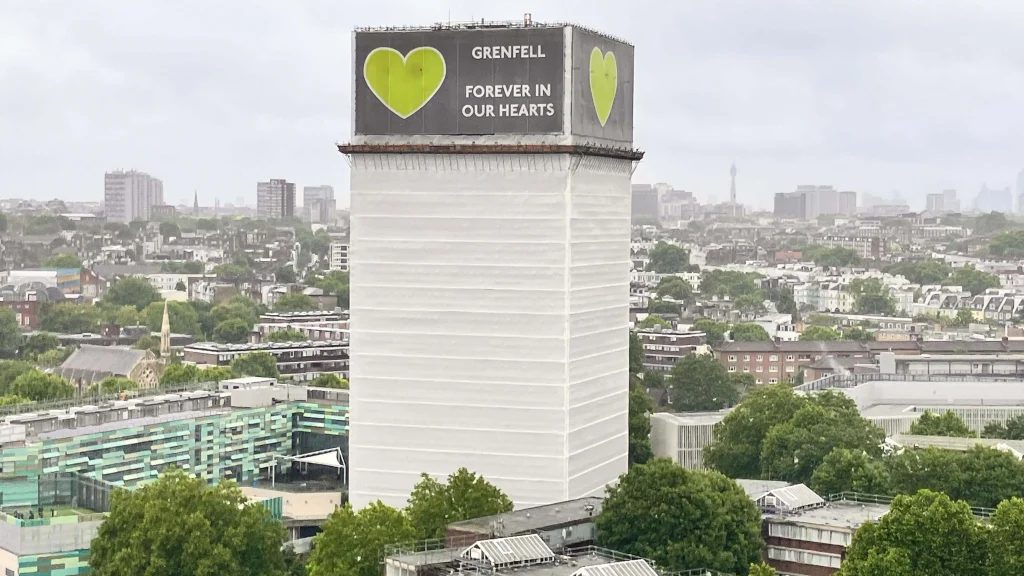
A fierce legal standoff has forced the British government to abruptly halt parts of the Grenfell Tower demolition. Grieving families threatened immediate legal action this week. They demanded the preservation of harrowing final marks left by their loved ones. Consequently, the heavy machinery has fallen silent on specific floors of the burned-out shell.
This development marks a crucial turning point for the bereaved community. Families recently discovered handprints seared into the blackened stairwell walls. They firmly believe these belong to victims or desperate survivors of the 2017 inferno. The fight to save these physical memories has directly disrupted the highly sensitive Grenfell Tower demolition process.
The government previously refused to preserve any structural elements above the ninth floor. Officials cited extreme sensitivity and the tragic loss of life at those higher levels. However, families argued that erasing these marks would destroy vital historical evidence. The community views these artefacts as essential for a future permanent memorial.
The Legal Battle Halting the Grenfell Tower Demolition
Grenfell Next of Kin (GNK) represents many families of the deceased. The advocacy group fiercely opposed the government’s initial refusal. They filed a formal pre-action letter last week. This legal maneuver sought a judicial review of the controversial decision.
The threat of a high court battle yielded immediate results. The government’s legal department quickly ordered a partial stop to the works. Officials confirmed that sections between the 12th and 14th floors are now strictly cordoned off.
“Due to ongoing legal action, we have paused deconstruction works in the relevant areas,” stated a spokesperson for the government ministry responsible for Grenfell.
Meanwhile, heavy deconstruction continues on other floors. GNK representatives expressed deep frustration regarding the process. They noted that this crucial protection was only secured through legal force. The families felt backed into a corner by unyielding bureaucratic decisions.
Haunting Discoveries Inside the Burned Structure
The discoveries inside the tower are undeniably chilling. Families accessed the site during organized pre-demolition visits. Walking through the dark, skeletal remains of the building, they found physical remnants of the tragedy.
The most striking finds were human handprints pressed against the stairwell walls. These marks capture the desperate final moments of residents trying to escape the smoke and flames. Furthermore, visitors discovered a poignant religious inscription on another upper floor.
Someone had written “Allahu Akbar” (“God is greatest”) in Arabic on the wall. Sadly, the legal intervention came too late to save this specific message. The government confirmed that the walls between the 17th and 18th floors have already been destroyed. This irreversible loss has only intensified the community’s determination to protect the remaining handprints.
Broken Promises and the Future Memorial
The conflict over these walls highlights deep-seated mistrust between the community and the state. GNK pointed directly to past political assurances. They highlighted a specific commitment made by former deputy prime minister Angela Rayner in 2025.
Rayner previously promised that parts of the tower could be preserved. She stated this would happen if the community desired it for a memorial. The recent refusal to save the upper-floor artefacts felt like a profound betrayal of that pledge.
Families are now urging the government to completely protect these sensitive areas. They want the freeze to last while intensive discussions take place. Memorial designers and community leaders need time to assess how to safely integrate these walls into a future site of remembrance.
Historical Context: A Tragedy That Changed Britain
Understanding this fierce preservation battle requires looking back at the original tragedy. In June 2017, a catastrophic fire tore through the 24-storey social housing block. It killed 72 people in one of the deadliest structural fires in modern British history.
The disaster occurred in one of London’s wealthiest boroughs. This stark geographical contrast immediately highlighted deep socio-economic divides in the UK. The fire sparked a nationwide reckoning over social housing conditions and building safety.
It exposed the widespread use of highly flammable exterior cladding. This revelation triggered a massive, multi-billion-pound crisis across the global construction industry. Hundreds of thousands of residents worldwide realized they were living in unsafe buildings.
Consequently, Grenfell Tower became far more than just a ruined apartment block. It stands as a global symbol of systemic negligence and corporate greed. Therefore, the physical remnants of the building carry immense historical weight.
Why Preserving Physical Trauma Matters
The debate over the Grenfell artefacts mirrors other global memorial efforts. Historically, preserving physical evidence of a tragedy helps future generations understand the true human cost. Museums surrounding the 9/11 attacks or the Holocaust deliberately feature harrowing physical artefacts.
These objects anchor the tragedy in reality. They prevent historical revisionism. For the Grenfell families, the handprints serve a similar, crucial purpose. They are undeniable proof of the human struggle that occurred inside those walls.
Erasing them in the name of “sensitivity” feels, to many, like an attempt to sanitize a brutally uncomfortable history. The state’s initial desire to clear the site quickly clashed violently with the community’s need to remember accurately.
What Happens Next in the Wrecking Process?
The immediate future of the tower remains highly uncertain. The structural dismantling officially began in September 2025. The process was painstakingly designed to minimize disruption to the surrounding neighborhood.
Currently, the demolition is operating under a split mandate. Workers are carefully tearing down the unrestricted zones. Simultaneously, the cordoned-off floors sit in legal limbo.
The government must now formally respond to the pre-action letter. Their legal reply will likely determine whether the bulldozers return to the 12th floor. Until then, the handprints remain safe, hidden within the scaffolding, awaiting a final verdict on their survival.
__________________________________________________
Global Turmoil Fails to Crack Canadian Currency as Oil Surges