The clock is ticking on a devastating humanitarian disaster in the Horn of Africa. Right now, a staggering 6.5 million people stand on the edge of a severe Somalia hunger crisis. The International Committee of the Red Cross (ICRC) has officially sounded the alarm. Prolonged, unforgiving drought is actively destroying lives and completely eroding agricultural livelihoods across the nation.
This impending catastrophe is not developing in a vacuum. It is the grim result of intersecting emergencies. Climate anomalies, ongoing regional violence, and a sudden drop in international financial support are creating a perfect storm of suffering.
An Economy Turned to Dust
Somalia relies heavily on its traditional pastoralist economy. In rural regions, livestock is much more than mere property to be managed. Animals serve as the fundamental currency of survival, trade, and social stability.
Currently, massive animal die-offs are sweeping across the scorched landscape. This biological wipeout is stripping vulnerable families of both their daily food supply and their only reliable source of income.
Abdulkadir Mohamed Farah, a local herder struggling to survive in the Galmudug region, represents the human face of this statistical nightmare. In less than a single year, the changing climate has decimated his life’s work.
“We are facing a lack of rain. The livestock, both camels and goats, have been lost. Now we fear that people may follow,” Farah said. “I had 500 goats, only 50 remain. I had 70 camels, 20 are left.”
Losing 90% of a herd represents total economic collapse for a rural household. When the generational wealth of a family evaporates into the arid soil, severe malnutrition inevitably follows.
The Shadow of the 2022 Somalia Hunger Crisis
The current climatic disaster is deeply troubling to climate scientists and humanitarian experts alike. It is the direct consequence of two consecutive failed rainy seasons. Consequently, the scorched earth has had zero opportunity to recover or regenerate pasture.
This harsh reality is sparking deep, immediate fears among aid organizations. Many dread a terrifying repeat of the catastrophic 2022 famine conditions. During that dark period, the Horn of Africa witnessed some of the worst starvation metrics recorded in modern history.
Historically, severe droughts in this region occurred roughly once every decade. This allowed fragile ecosystems and pastoral communities time to rebuild. Now, the cycle has shortened dramatically, leaving zero window for herd recovery.
The Twin Engines of Displacement
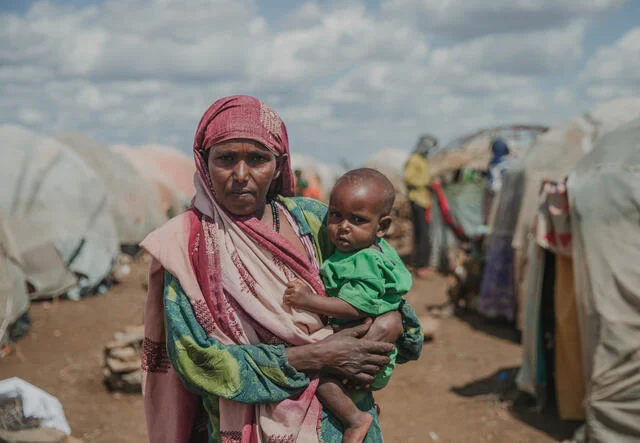
As natural water reservoirs turn to cracked mud, survival strategies must urgently shift. Thousands of desperate families are completely abandoning their ancestral rural lands. They are embarking on perilous migrations toward overcrowded displacement camps and larger urban centers in a desperate search for water.
However, the agonizing lack of rain is only one half of the national nightmare. Violent, ongoing conflict continues to dangerously fracture the nation.
“The fighting has caused displacement. The drought is also causing displacement. The needs are increasing, and the situation will become desperate if the rains don’t come soon,” warned Mohamed Sheikh, an ICRC officer stationed in Galmudug.
This mass climate migration severely strains the limited infrastructure of host cities. Displacement camps rapidly transform into overcrowded breeding grounds for infectious diseases. When clean water is scarce, basic sanitation is always the first casualty.
The Silent Threat of Critical Aid Cuts
The escalating Somalia hunger crisis is being artificially accelerated by a critical, sudden drop in global funding. International aid cuts are arriving at the absolute worst possible moment for the Somali people.
Global donor fatigue and overlapping international conflicts have diverted media attention and crucial capital away from Africa. As a direct result, essential relief programs inside Somalia are actively shutting their doors.
This financial drought translates to less clean water trucking, heavily reduced food rations, and collapsing local health support. It creates a lethal vacuum right when the population is at its absolute weakest.
When aid budgets are slashed, humanitarian workers face impossible, heartbreaking choices. They must constantly decide which starving community receives emergency rations and which one is left to wait.
Broader Health and Security Implications
When an agricultural system fails at this massive magnitude, the ripple effects damage every single layer of society. The most immediate impact is acute malnutrition, which systematically destroys the human immune system.
Common illnesses that are normally highly treatable suddenly become fatal within days. Children under five face the absolute highest mortality risks in these bleak scenarios. Furthermore, desperation takes hold when young men lose their traditional livelihoods entirely.
This dangerous economic vacuum can easily be exploited by regional armed groups. It fuels the exact same conflict that currently drives displacement, creating a vicious, self-perpetuating cycle of regional instability.
Urgent Interventions Required Immediately
To prevent this severe Somalia hunger crisis from escalating into a full-scale, uncontrollable famine, immediate interventions are desperately required. The international community must prioritize rapid, localized, and fully funded responses.
Key urgent requirements include:
-
Emergency water trucking to highly isolated, drought-stricken rural communities.
-
Therapeutic food supplies specifically formulated for severely malnourished children.
-
Direct cash transfer programs to stimulate surviving, fragile local markets.
-
Emergency veterinary care to save the remaining, severely weakened livestock.
Without these immediate injections of support, traditional rural communities will simply cease to exist.
A Desperate Wait for Rain
The skies over Somalia remain stubbornly, terrifyingly clear. Every single day without significant precipitation pushes thousands of vulnerable citizens closer to the edge of the abyss.
The ICRC’s warning is not merely a standardized plea for funds; it is a stark, mathematical reality. When herd animals die at this unprecedented rate, human mortality curves historically follow the exact same downward trajectory.
The crucial window for preventative action is rapidly closing. The international community must decisively reverse the current aid cuts immediately. If the rains fail again and funding remains stagnant, the ultimate outcome will undoubtedly be measured in millions of lost lives.
_____________________________________________________