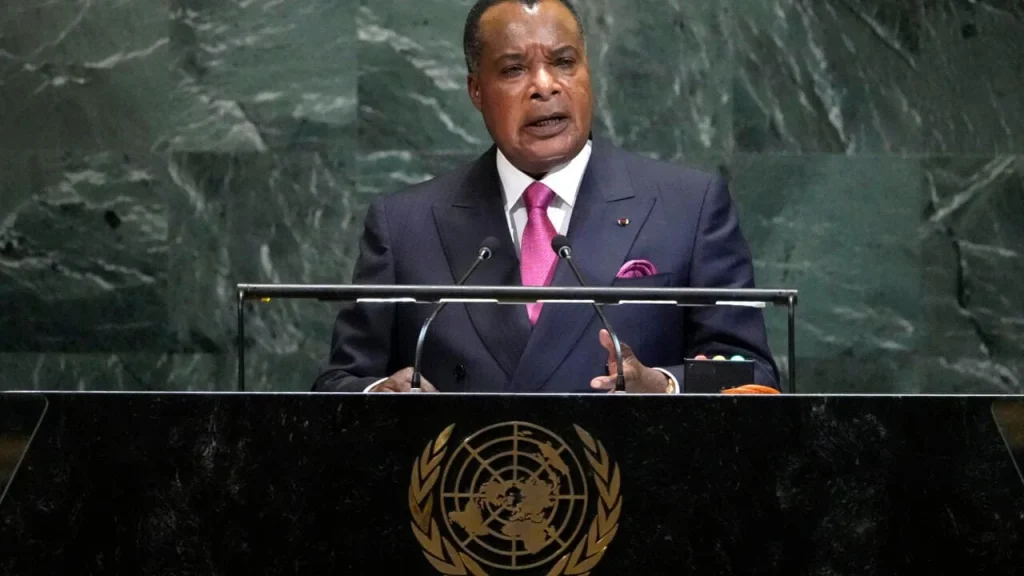
In a massive move that solidifies the current political trajectory of Central Africa, President Denis Sassou Nguesso has officially confirmed he will seek re-election in the upcoming presidential polls. This national vote, a high-stakes event for the entire region, is scheduled to take place over two stages on March 12 and 15, 2026.
The announcement, delivered on Thursday, February 5, 2026, finally ends months of intense speculation. It sets the stage for a campaign centered on “unwavering continuity” and the long-standing influence of the incumbent leader. For a nation at the heart of the Congo Basin, this declaration is not just about a single election; it is about the future of a legacy that has spanned nearly half a century.
The Announcement: A Brilliant Masterclass in Political Symbolism
The President chose a highly grounded and strategic setting for his declaration: an agricultural fair. In a scene designed to project a connection with the common citizen and the nation’s food security goals, Nguesso broke his silence. When questioned by the press and fair participants regarding his intentions for the March ballot, he provided a definitive confirmation that he would indeed be on the ticket.
However, political observers noted that the most profound element was the symbolism of the date itself. February 5 holds deep, almost sacred historical significance in the Republic of Congo.
It was on this exact day in 1979 that Nguesso originally began his first term as the nation’s leader—then heading the People’s Republic of the Congo. By choosing this precise anniversary to announce his latest bid, the President has signaled a desire to connect his modern mandate with his foundational entry into Congolese leadership. This symbolic link portrays his candidacy not as a mere choice, but as a historical necessity.
A Legacy Spanning Decades: The Two Eras of Nguesso
At 82 years old, Denis Sassou Nguesso remains the undisputed defining figure of Congolese politics. His tenure is not a single block of time but is marked by two distinct and dramatic periods of governance:
1. The Early Years (1979–1992)
During his first stint, Nguesso governed for thirteen years. This period concluded as the African continent underwent a massive shift toward multi-party systems in the early 1990s. He stepped down following an election in 1992, marking a rare peaceful transition of power at the time.
2. The Modern Era (1997–Present)
After a five-year hiatus—a period tragically defined by civil conflict—Nguesso returned to the presidency in 1997. He has remained the head of state ever since, navigating the complexities of post-war reconstruction and the global oil market.
Since his return to power, Nguesso has secured victories in four consecutive elections held in 2002, 2009, 2016, and 2021. If he emerges victorious in the upcoming March 2026 vote, it will mark his sixth consecutive term since the late 1990s, making him one of the longest-serving leaders in modern history.
The Constitutional Context: Breaking the Traditional Cap
The legal path to this historic re-election bid was established over a decade ago. In 2015, Nguesso orchestrated a pivotal constitutional amendment. This massive legal shift removed previous term limits and age restrictions that would have otherwise barred him from running.
This amendment effectively granted him the legal standing to remain in office beyond the traditional two-term cap. Supporters argue that this was a necessary step to ensure “institutional stability” in a volatile region. However, critics view it as the moment the “ultimate power play” was legalized, ensuring that the transition of power remains a distant prospect.
A Heated Political Climate: Stability vs. Dissent
While the ruling party and senior officials have spent months championing Nguesso’s candidacy as “essential for national security,” the road to March 2026 is far from smooth. The political climate in Brazzaville and beyond remains charged. Throughout his tenure, the political opposition has consistently raised three core concerns:
- Electoral Transparency: Critics frequently allege that election results and the voter registration processes are tailored to favor the incumbent, leading to a lack of faith in the democratic process.
- Repression of Dissent: There have been recurring accusations of marginalizing, silencing, or ignoring opposition voices and civil society activists during previous cycles.
- The Call for Reform: There is a growing, audible call from the younger generation for a transition to a “new leadership” that reflects the demographics of a country where the majority of the population was born after Nguesso first took power.
Strategic Outlook: The Road to March 12 and 15
With the official confirmation now public, the government’s focus shifts to the complex logistical execution of the March elections. The dual-date voting process is intended to ensure maximum participation across the country’s diverse and often geographically challenging regions.
The international community, particularly regional neighbors and oil-sector investors, will be watching closely. The Republic of Congo is a significant player in the Central African economy, and its political stability is a linchpin for the wider Congo River Basin.
Conclusion: Congo at a Historical Crossroads
As the official campaign begins, the Republic of Congo stands at a definitive crossroads. On one side is the promise of “Stability and Continuity” offered by the Nguesso administration—a promise of a known path and an experienced hand. On the other side is the “Urgent Need for Change” sought by an opposition that feels sidelined by decades of the same leadership.
Whether March 2026 results in a reaffirmation of the status quo or a shocking shift in the political landscape, one thing is certain: Denis Sassou Nguesso’s announcement has ensured that the eyes of the world will be on Brazzaville this spring.
READ ALSO: Iran Threatens to Label European Union Militaries as “Terrorist” Entities