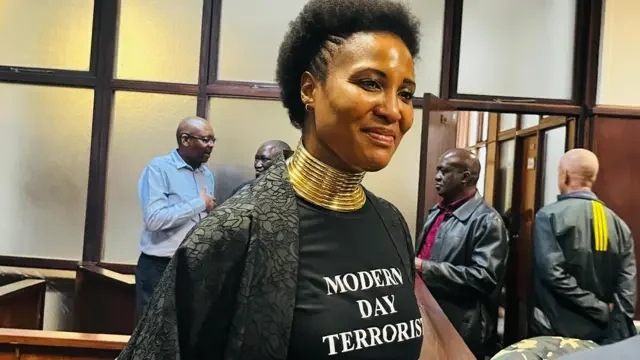
Duduzile Zuma-Sambudla, daughter of former South African President Jacob Zuma, appeared before the High Court in Durban on Monday. She officially responded to charges of inciting public violence.
The defendant entered a definitive plea of not guilty to the accusations. These criminal allegations are directly connected to the devastating civil unrest that swept across parts of the nation in 2021. The ensuing period of chaos tragically claimed over 300 lives.
The Outbreak of National Unrest
The violence began suddenly in July 2021. It was immediately triggered by the arrest of the former head of state, Jacob Zuma.
His detention resulted from his refusal to comply with a court order requiring his testimony at a high-profile inquiry into corruption.
The initial protest quickly accelerated beyond control. It rapidly transformed into widespread mass looting and destructive chaos across the provinces of Gauteng and KwaZulu-Natal.
The economic destruction caused by the riots was massive. Authorities estimated the financial toll to be approximately 50 billion rand about $2.9$ billion.
Zuma-Sambudla was present in court for the formal commencement of her trial regarding the civil disorder. Prosecutors presented their case, asserting she intentionally encouraged others toward acts of destruction and violence.
The key evidence relies on a pattern of posts she allegedly published on various social media platforms. The prosecution’s argument centers on interpreting her digital communication as a direct call to anarchy.
Family and Political Support
The courtroom proceedings were intensely monitored, underscoring the deep political divisions surrounding the case.
Former President Jacob Zuma was a prominent presence in the High Court. He governed South Africa from 2009 to 2018. Despite his controversial departure from office, he still commands a significant base of support throughout the country. His appearance was a powerful public show of solidarity with his daughter.
He was seated with senior figures from his recently established political movement, uMkhonto we Sizwe (MK). This party emerged as a potent disruptor in the national election held last year.
The strong showing by the MK party contributed substantially to the decline in support for the African National Congress (ANC), the powerful political body Zuma once chaired. The trial, therefore, serves as a significant platform for the MK party’s ongoing challenge to the established political order.
The Broader Implications of the Trial
The case carries immense weight, extending far beyond the specific criminal charges. It challenges the legal boundary between free expression and incitement in the digital era, especially when online content precipitates real-world destruction and death.
For the nation’s justice system, the trial is a critical measure. It aims to deliver accountability for one of the deadliest periods of civil instability since the end of apartheid. For the current government, securing a conviction is viewed as necessary for reinforcing the rule of law.
Conversely, the defense argues the proceedings are politically motivated. They suggest the true goal is to silence the former President’s family and weaken his political influence. The verdict will undoubtedly shape South Africa’s political dynamics and public conversation ahead of upcoming elections.
Historic Appointment: Nigerian Priest Elevated to Papal Household Role