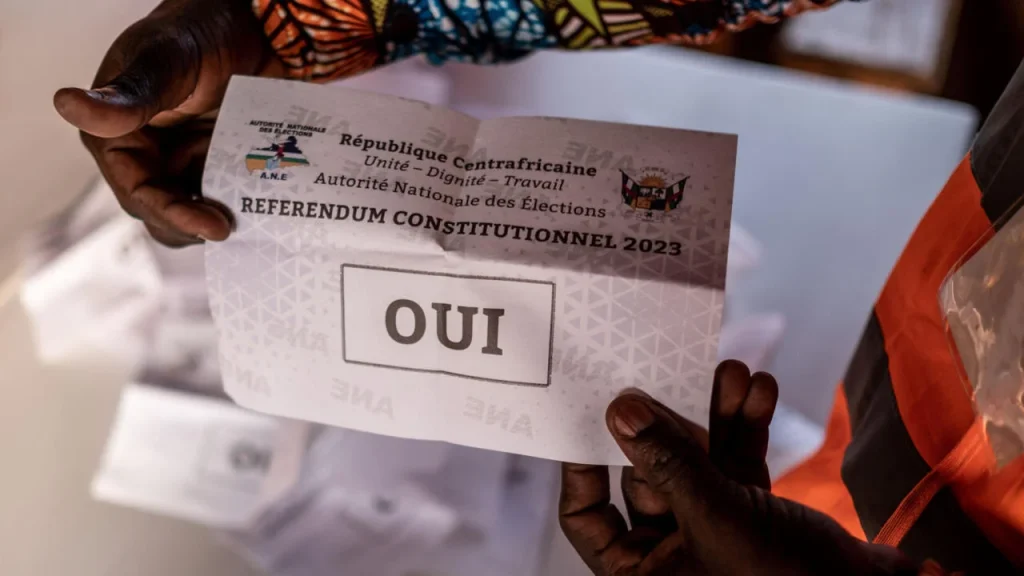
On August 7, 2023, the Central African Republic’s National Election Authority announced that 95.27% of voters approved a new constitution in the July 30 referendum, with a reported 61.10% turnout. The changes extend the presidential term from five to seven years and abolish the two-term limit, allowing President Faustin-Archange Touadera to run for a third term in 2025. The Constitutional Court validated these results on August 21, despite a boycott by major opposition parties, civil society groups, and armed rebels, who labeled the process a “farce” and accused the government of undermining democracy.
Opposition and Allegations of Foul Play
The opposition, led by figures like Crepin Mboli-Goumba of the BRDC coalition, denounced the referendum as “a comedy,” citing low voter turnout and a lack of transparency. “We’ve all seen that people didn’t go out to vote,” Mboli-Goumba told AFP, pointing to an outdated electoral register and non-independent institutions. Human Rights Watch reported that government officials “cajoled and threatened” opponents, with authorities banning an opposition rally in Bangui to suppress dissent. The forced retirement of Constitutional Court president Daniele Darlan in January 2023, after she opposed an earlier reform attempt, fueled claims of a “constitutional coup.”
Touadera’s Power Consolidation
Touadera, first elected in 2016 and re-elected in 2020 amid fraud allegations, has relied on Russian Wagner Group mercenaries since 2018 to bolster security against rebel groups. The new constitution creates a vice-presidency, weakens the National Assembly’s oversight of mining contracts, and transforms the Constitutional Court into a government-dominated council, consolidating Touadera’s grip on power. Critics, including opposition leader Martin Ziguele, accuse him of seeking a “presidency for life.” The referendum’s 95% approval, despite reported low turnout in areas like Bangui, suggests manipulation, with Wagner providing security and logistical support.
Regional and International Concerns
The referendum’s lack of independent observers and its alignment with similar moves in Rwanda, Congo, and Ivory Coast raise fears of democratic backsliding in Africa. The U.S. State Department expressed “deep reservations” over low participation and ballot secrecy, urging local elections. The CAR’s resource-rich but impoverished status, coupled with ongoing rebel activity, heightens the stakes. Wagner’s involvement, including securing mining deals, underscores Russia’s growing influence, complicating Western efforts to stabilize the region post-independence from France in 1960.
Implications for CAR’s Future
Touadera’s path to a third term risks deepening instability in one of the world’s poorest nations. The opposition’s boycott and exclusion of dual nationals from candidacy, affecting figures like Anicet Georges Dologuélé, signal a clampdown on dissent. “The vote was a plebiscite for Touadera,” said International Crisis Group’s Charles Bouessel, noting the constitution was “tailored to bypass regime obstacles.” As the 2025 election looms, the CAR faces heightened political and security challenges, with the junta’s reliance on foreign mercenaries and public discontent threatening further turmoil.