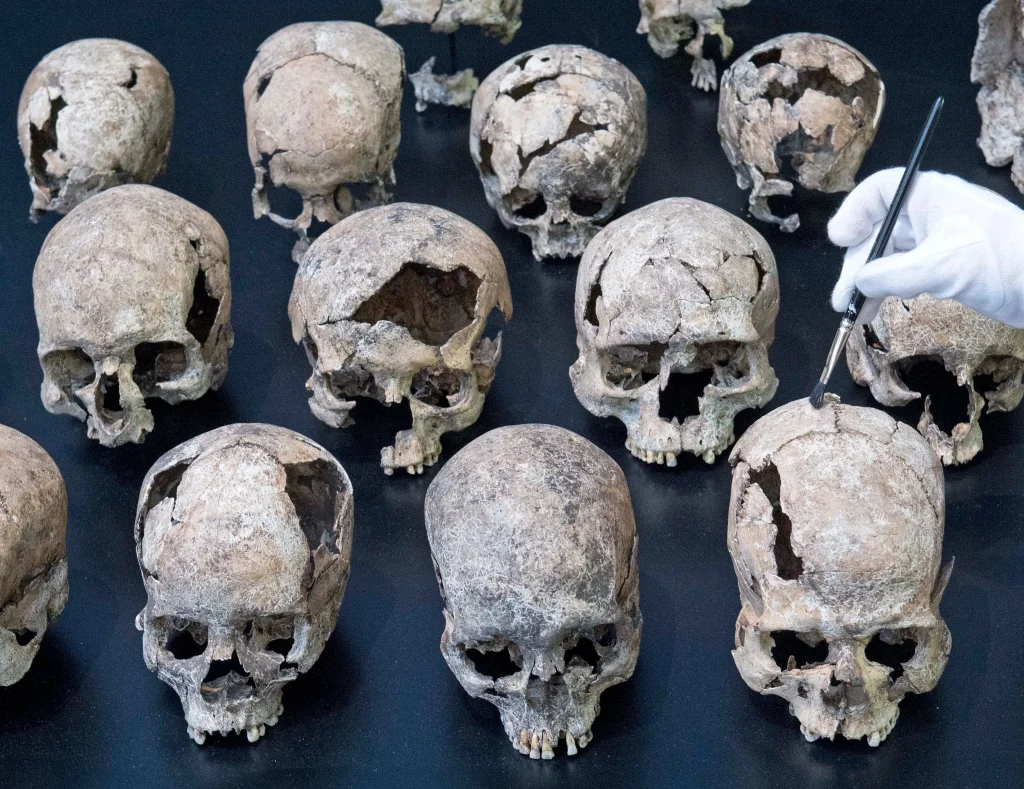
Scientists examined 1,135 skulls at Berlin’s Museum of Prehistory and Early History, assigning 904 to areas that are now part of Rwanda, 202 to Tanzania and 22 to Kenya.
Another seven skulls remain unattributed.
German East Africa, established in the 1880s and broken up after the end of World War I in 1918, included present-day Burundi, Rwanda, mainland Tanzania and part of Mozambique.
According to Hermann Parzinger, president of the Prussian Cultural Heritage Foundation, which oversees many of Berlin’s museums: “We are ready for immediate restitution and are now waiting for signals from the countries of origin.”
In a tweet, Parzinger also hailed the collaboration of Rwandan scholars, who searched local archives to try and pinpoint where the remains came from.
Skulls from burial sites and executions
The vast majority of the skulls originate from cemeteries and other burial sites, according to a statement by the foundation, but some were taken from executions carried out locally or by Germans.
The remains were part of a collection of more than 6,000 skulls assembled by doctor and anthropologist Felix von Luschan during German colonial rule.
They were taken over by the Museum of Prehistory and Early History from Berlin’s Charité hospital in 2011.
Improper storage had led to some of the skulls becoming damaged or mouldy, according to the museum’s curator, Bernard Heeb, who’s managing the project to research their provenance.
The first step was to clean and repair the remains, he said in 2017: “Today, all of the skulls are stored with the dignity they deserve.”
Restitution movement
The human remains were then examined and inventoried in a pilot project that Heeb said he hoped would “serve as a model for a general reassessment of colonial-era collections, not just the collection in Berlin”.
Since 2011 Germany has been returning remains to Namibia of indigenous Herero and Nama people murdered by German colonial forces.
In recent years, pressure has grown to return human remains and artefacts that were pillaged by European colonialists.
Among the most famous are hundreds of the so-called Benin Bronzes, which were stolen by British colonial troops before ending up in museums across Europe and the United States.
Germany started returning its collection to Nigeria late last year following an agreement between Berlin and Abuja.