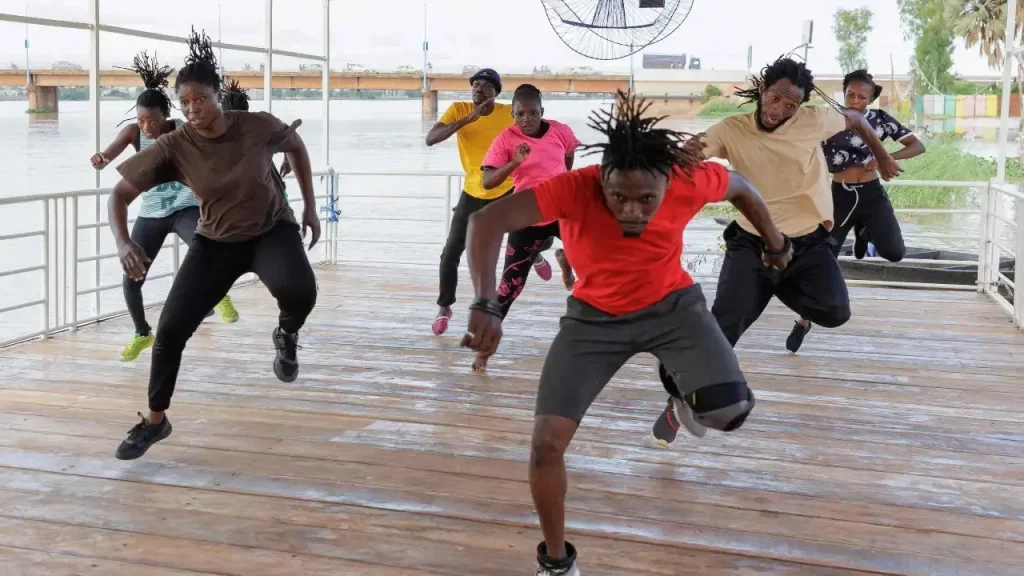
As dusk falls on Bamako, the capital of Mali, traffic builds along the banks of the Niger River. But away from the noise of car horns and busy vendors, another rhythm emerges on the water. A group of young dancers rehearse passionately aboard a boat, preparing to showcase Mali’s first-ever floating arts venue.
The birth of a cultural dream
The unique project, known as the Pirogue of the Zeme (translated as The Wise Man’s Canoe in the Bambara language), is the creation of dancer and choreographer Lassina Koné and renowned architect Cheick Diallo. Their idea was simple but bold: bring art to the people by turning the Niger River into a stage.
Koné recalls how the dream began. “Every second counts. Everything must be perfect tomorrow,” he said during rehearsals, his determination evident. Around him, welders and painters worked to finalize the vessel’s structure. For Diallo, the collaboration was fate. “Lassina came to me and said, ‘Hey, old guy, I have a dream — help me.’ I realized I had the same dream too. So we teamed up.”
Taking art beyond city walls
The floating stage is designed for dance, theatre, puppetry, and visual exhibitions, transforming art into a mobile experience accessible to communities along the Niger River. Audiences gather on the riverbanks to watch performances, making art a shared celebration rather than something confined to city theaters.
The vessel itself is an impressive creation: a 20-meter-long, 6-meter-wide wooden and steel boat, covered with light matting to protect against sun and rain. Though modest in size, it is large enough to host dynamic performances, while still feeling the natural movements of the river.
Courage in difficult times
Mali has faced years of political instability and a decade-long jihadist insurgency, leaving many communities under strain. For Koné and Diallo, art is more than entertainment—it is a tool for resilience and unity.
“We artists have the right to be crazy,” Diallo explained. “It’s craziness that breaks through the boundaries of everyday life. This project was the meeting of two crazies.”
Despite doubts, their persistence paid off. With partial funding from the European Union, totaling nearly $300,000, the Pirogue of the Zeme became reality after five months of construction.
The challenge of performing on water
For the troupe of young performers, adapting to the floating stage brought new experiences. Assetou Aida Doumbia, 24, admitted she was surprised at the idea. “It’s really different, but we are 100 percent ready,” she said. Fellow dancer Yacouba Coulibaly, 28, added, “This is the first time I’ve been on a boat, and it’s a particular challenge to dance here.”
Their determination mirrors the spirit of the project: overcoming obstacles to showcase Mali’s creativity and inspire others.
A different side of Mali
The EU’s ambassador to Mali, Bart Ouvry, highlighted why supporting the project matters. “This is a way of getting to know a different Mali,” he said. Beyond performances, he stressed that culture plays a role in keeping young people engaged, preventing them from turning to destructive paths.
“It tells investors that Mali is a land of creativity,” Ouvry added, underlining how cultural projects can reshape perceptions of a country better known for conflict.
Hope on the Niger River
As twilight gives way to night, the floating stage glides on the river, carrying the hopes of its artists and the pride of a nation. For many Malians, the project is more than a performance—it is a reminder that creativity can flourish even in the face of hardship.
The Pirogue of the Zeme now sails not only as a boat but as a symbol of resilience, unity, and the transformative power of art.