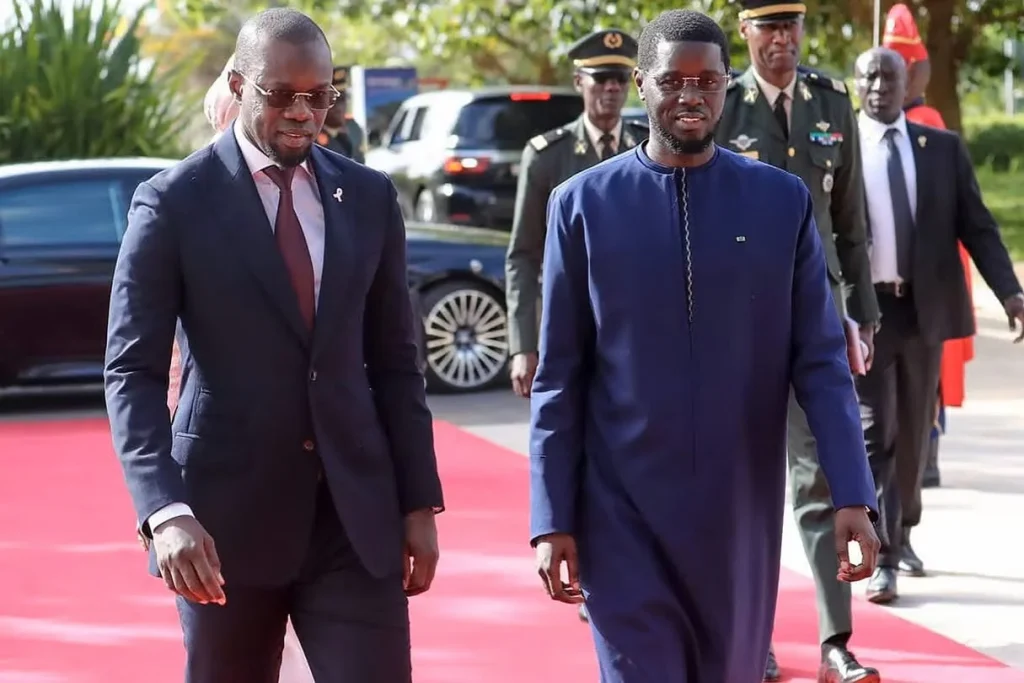
A significant public dispute over political control has emerged between Senegalese President Bassirou Diomaye Faye and his Prime Minister, Ousmane Sonko.
The highly visible confrontation threatens the stability of the national governing coalition and raises critical questions about the true balance of executive power.
Executive Overreach Triggers Feud
The conflict erupted on Tuesday when President Faye took a dramatic, independent action. He announced the removal of Aïssatou Mbodj from her leadership role in the “Diomaye Président” coalition, the alliance responsible for his 2024 electoral victory. Mbodj is a key political ally of Prime Minister Sonko.
The President immediately installed his own campaign manager, Aminata Touré, as Mbodj’s replacement.
This decision was a direct repudiation of a recent public declaration by Sonko, who had stated explicitly that the coalition leadership would remain unchanged. Faye’s unilateral appointment is widely seen as a deliberate move to curb the Prime Minister’s political influence.
Party Rejects Presidential Authority
Prime Minister Sonko’s political organization, the Pastef party, responded swiftly and with open defiance. The party leaders met and subsequently issued a formal statement rejecting the legitimacy of the President’s action.
Pastef formally asserted that President Faye lacks the constitutional authority to dismiss Mbodj from her coalition role. The statement also sharply declared the party does not share the fundamental “values nor the same principles” of the President’s chosen replacement, Aminata Touré, indicating a deep philosophical split at the heart of the administration.
Profound Uncertainty for Governance
This open clash, carried out through official communiqués, reveals a foundational battle for governing authority within the new administration. Political analysts are now expressing serious doubts about President Faye’s ability to rule effectively.
Sonko retains significant public popularity and leads a powerful political party, demonstrated by the massive public support he recently mobilized.
The ongoing confrontation has severely weakened the ruling alliance. It pushes the West African nation into a period of acute political instability regarding the leadership structure of the government.