Nigeria’s financial markets commenced November 2025 on a negative trajectory. Both the national currency and the equities market experienced sharp declines following comments made by U.S. President Donald Trump. The President had publicly threatened potential military action against Nigeria over alleged religious persecution.
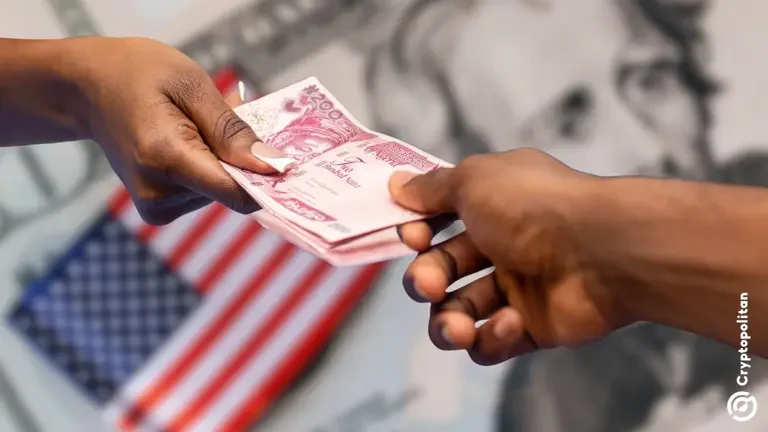
Data from the central banking authority confirmed the currency’s decline. The naira, which had reached a 2025 high of (N1,421.73)/$, depreciated to (N1,436.340)/$ on Monday. This drop marked a 1.03 percent loss in value within a single day.
The currency also weakened in the parallel market, trading at (N1,455)\$. This movement reflected heightened investor anxiety and increased demand pressure for foreign exchange.
Geopolitical Tension Fuels Market Bearishness
The sudden market deterioration followed a weekend of intense geopolitical tension. President Trump had used his social media platform to label Nigeria a “country of particular concern.”
He subsequently directed the U.S. Department of War to prepare for “possible action” if the alleged killings of Christians persisted.
The President described this move as a necessary response to a “Christian genocide” in Nigeria. This claim sparked widespread global debate and created uncertainty regarding the diplomatic and economic implications for Africa’s largest economy.
Equities Market Suffers Setbacks
The downturn quickly affected the Nigerian Exchange Limited. Bearish trading resumed on Monday, pushing the All-Share Index down by 0.25 percent to close at 153,739.11 points.
This decline trimmed the market’s year-to-date gains to 49.37 percent. Consequently, market capitalization decreased by (N245.88 billion), settling at (N97.58 trillion).
The drop was primarily caused by significant selloffs in Aradel Holdings (-9.21 percent) and Access Corporation (-3.07 percent). Investor sentiment remained weak, with 38 stocks recording losses against 19 gainers. Union Dicon emerged as the top gainer (+9.93 percent), while Honeywell Flour Mills led the losers (-10.00 percent).
Trading activity across the board slowed sharply. Total volume traded plunged by 87.94 percent, and the total value traded dropped by 44.64 percent, settling at 627.5 million units worth N25 billion. United Bank for Africa dominated the session, accounting for 21.8 percent of total volume and 22.2 percent of total value.
Sector Performance and Bond Market Jitters
Performance across sectors was mixed:
- Losses: Oil & Gas (-3.94 percent), Commodities (-1.85 percent), Insurance (-1.48 percent), and Banking (-0.22 percent) all recorded declines.
- Gains: The Consumer Goods sector rose slightly by 0.49 percent. The Industrial sector closed flat.
In the bond market, investor demand for Nigeria’s Eurobonds weakened. Average yields increased by 5 basis points, settling at 7.70 percent. Investment firms attributed this deterioration to global risk aversion, macroeconomic uncertainty, and the heightened geopolitical concerns.
Dollar-denominated bonds were the worst-performing among emerging markets on Monday. Bonds maturing in 2047 recorded the steepest decline, falling 0.6 cents on the dollar before recovering some losses later in the day.
Analysts Debate Impact of External Threats
While some analysts viewed the immediate market reaction as temporary, others warned of long-term damage. One financial expert described the market’s response as a “mere blip,” arguing that the downturn was “not sustainable.” He noted that global closing prices already showed signs of recovery and stressed that the country’s fundamentals remain strong for long-term investment.
However, another expert, Dr. Musa Yusuf, Chief Executive Officer of the Centre for the Promotion of Private Enterprise, warned that the President’s statements could seriously undermine investor confidence.
“The U.S. President’s threat of military intervention in Nigeria is unwarranted, counterproductive, and economically destabilizing,” Yusuf warned.
He argued that such remarks send unsettling signals, heighten risk perception, and undermine confidence in the national economy.
Yusuf emphasized that while Nigeria must continue to strengthen internal security, any engagement with foreign powers “should be cooperative, not coercive.” He concluded that unilateral military action “would destabilize Nigeria’s economy, threaten regional stability, and worsen humanitarian conditions.”
Sustained stability, analysts agree, will depend on calm, confidence-building measures, and consistent macroeconomic policy from the central bank and the government.
Nigeria Secures $2.35 Billion External Loan to Fund 2025 Budget