
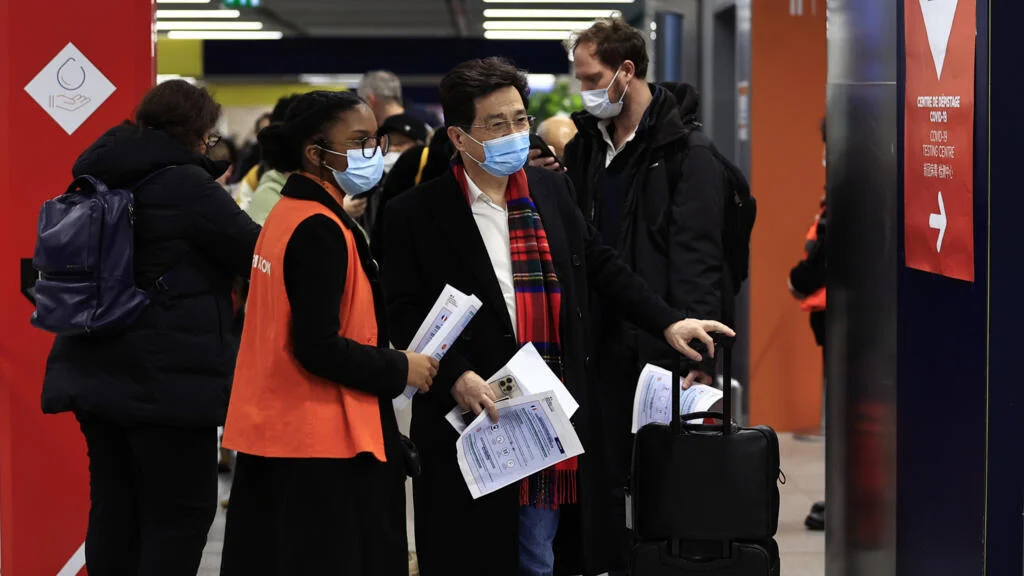
France has announced that it will extend mandatory Covid-19 testing for travellers arriving from China until 15 February, citing what officials call an “evolving situation” regarding the spread of the virus.
The French government had initially imposed the requirement only until 31 January, but authorities say the measure remains necessary due to the continuing wave of infections across China.
Testing rules for travellers from China
Since the beginning of January, all passengers over the age of 11 arriving in France from China have been required to present a negative Covid-19 test result taken within 48 hours of departure. Airlines are instructed to check passengers’ results before boarding.
In addition, random tests will continue to be carried out upon arrival in France. Anyone who tests positive will be required to self-isolate. The French health ministry has also made face masks compulsory for everyone over six years old travelling on flights between China and France.
Why the restrictions remain in place
Several countries, including the United States, Japan and Italy, have introduced similar measures in response to the sharp rise in infections in China. The concern stems from Beijing’s decision to suddenly relax its strict zero-Covid policy in December, which had previously relied on mass testing, lockdowns and quarantines.
Since then, China has faced a major surge in Covid cases. Hospitals and crematoriums in several regions have reported being overwhelmed, even though Beijing has released limited official data.
According to Chinese authorities, the number of daily Covid-19 deaths has fallen by nearly 80 percent since the start of January. However, international experts remain cautious, pointing out that China uses a narrow definition of Covid deaths, which excludes many cases that would be counted in other countries. As a result, the true scale of the outbreak remains uncertain.
International response and ongoing monitoring
French officials argue that the temporary restrictions are a matter of public health and necessary for protecting vulnerable groups. “We must remain vigilant in the face of evolving risks,” one government spokesperson said, highlighting that monitoring imported cases is essential to prevent fresh waves of infection within France.
Health experts in Europe also note that continuing the testing requirements allows authorities to track possible new variants emerging from China. Monitoring these samples could help identify whether mutations pose additional risks.
The European Union has encouraged its member states to adopt coordinated measures on travel from China, though enforcement remains up to each country. France has taken one of the stricter approaches by extending testing until mid-February.
Balancing safety and travel
While the decision has been welcomed by some public health groups, it has also drawn criticism from parts of the travel industry, which fear the rules may discourage tourism and business travel. Airlines have asked for greater clarity on how long the restrictions will remain in force, stressing the importance of predictability for international connections.
For now, France’s position is that the restrictions are temporary but necessary. Authorities have promised to review the situation in the coming weeks and make adjustments if the health risk declines.
As China continues to adapt to life after zero-Covid and the virus spreads through its vast population, the world remains cautious. For France, keeping testing requirements in place is seen as a preventive step to protect its citizens while maintaining international travel links.