In an era where wildlife trafficking usually brings to mind images of ivory tusks or rhino horns, a recent arrest at Jomo Kenyatta International Airport (JKIA) has shed light on a much smaller, yet ecologically devastating, trade. Security officials intercepted a massive haul of live insects this week. Consequently, authorities apprehended a Chinese national attempting to smuggle more than 2,000 live queen garden ants out of the country.
The suspect, identified as Zhang Kequn, was detained during a routine security screening. According to airport authorities, he was attempting to board an international flight destined for China. The discovery of this unusual cargo has triggered a high-level investigation into what experts call “biodiversity theft.”
A Sophisticated and Calculated Smuggling Operation
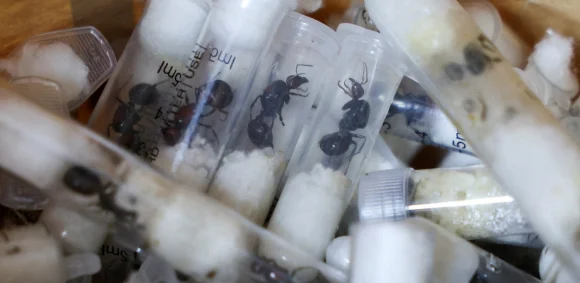
According to prosecutors handling the case, the method of concealment was not the work of an amateur. On the contrary, it was a highly specialized operation designed to keep the insects alive through a long-haul international flight. The ants were not simply dumped into bags; instead, they were meticulously packed using laboratory-grade equipment.
Investigators provided a shocking breakdown of the items seized from the suspect’s suitcases:
- 1,948 Queen Ants: Found carefully housed in specialized glass test tubes. These containers likely held enough moisture and oxygen to sustain the queens during transit.
- 300 Queen Ants: This secondary group was hidden inside three separate rolls of tissue paper. This is a common tactic used to bypass X-ray detection by softening the silhouette of the containers.
In total, Kenyan officials recovered over 2,200 insects. The ants were identified as Messor cephalotes, a species of giant harvester ant native specifically to the dry, arid regions of East Africa.
The Environmental Stakes: Why One Species Matters
The trade of Messor cephalotes is not merely an issue of illegal exports. It represents a direct threat to Kenya’s environmental stability. These insects are protected under various international biodiversity agreements. Therefore, their removal from the wild is strictly governed because of their profound ecological significance.
The Kenya Wildlife Service (KWS) has monitored an alarming rise in the illegal insect trade over the past three years. There is a surging demand for exotic African ants in premium markets across Europe and Asia. In these regions, wealthy collectors prize large, aggressive, or unique ants like the Messor cephalotes as “exotic pets.” A single queen, capable of starting a massive colony, can fetch a high price on the black market.
The Critical Role of Harvester Ants
Government officials and environmentalists emphasize that these ants are vital cogs in the Kenyan ecosystem. Their removal could lead to a chain reaction of environmental degradation.
Investigating the Global “Ant-Net” Trafficking Ring
Detectives from the KWS and Kenyan police believe this arrest is a major breakthrough. There are strong suspicions that Zhang Kequn is a key courier for a larger, sophisticated trafficking network. This syndicate likely operates across several African borders, sourcing rare insects for international buyers.
Although a similar ant-smuggling ring was dismantled by Kenyan authorities last year, experts believe the network has since rebuilt itself. In response to this latest threat, a local court granted the prosecution’s request to detain the suspect for an additional five days.
During this period, digital forensic experts will examine Zhang’s electronic devices. Investigators are specifically searching for:
- Buyer Lists: Identifying the end-collectors in China and Europe.
- Logistical Coordinators: Finding the individuals who organize the travel and specialized packing materials.
- Source Points: Identifying where in the Kenyan wild these specific colonies are being raided.
Conclusion: Protecting Kenya’s Biological Heritage
This arrest highlights a changing landscape in wildlife crime. As traditional contraband like ivory becomes harder to move due to intense international pressure, traffickers are turning toward smaller, “niche” species. These are easier to hide but remain equally valuable to collectors.
Kenyan authorities are now ramping up surveillance and training for airport security staff to recognize the signs of insect smuggling. The message from the KWS is clear: the nation’s biodiversity is not for sale, regardless of the size of the species.
The ongoing investigation into Zhang Kequn and his associates is expected to lead to further arrests in the coming weeks. For now, the 2,200 queen ants remain in the care of wildlife experts, with plans to eventually return them to their natural habitat.