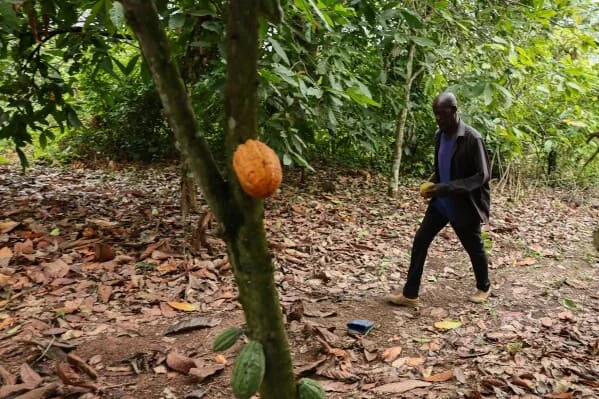
In the quiet village of Kouamé-Kouassikro, near Bouaflé in Ivory Coast, a heavy, bittersweet scent hangs in the air. It isn’t the smell of a bustling harvest; it is the scent of decay. Sacks of dried cocoa beans once considered “brown gold”—sit unsold in cramped homes and humid warehouses. Instead of the rustle of banknotes, farmers like Simplice Konan Konan clutch thin slips of paper: receipts that promise payment but offer no food for their families.
The global chocolate industry is currently witnessing a paradox. While consumers in London or New York pay premium prices for their treats, the people who grow the raw ingredients are facing financial ruin. A violent crash in international cocoa prices over the last year has left West African farmers holding the bag literally while their produce rots.
The Great Crash: From $12,000 to $4,000
To understand the current crisis, one must look back at the extreme volatility of 2024. That year, a massive surge in global demand and supply shortages sent cocoa prices skyrocketing to an unprecedented $12,000 per metric ton. It was a historic high, promising a new era of prosperity for the region.
However, the bubble burst. By early 2026, supply began to outstrip demand, and the market price plummeted to around $4,000. For international traders, purchasing beans at the high prices promised to farmers became a losing game. The result? Trade simply stopped.
The “I Owe You” Crisis in Ivory Coast
Ivory Coast is the world’s leading cocoa producer. To protect its citizens from the whims of the international market, the government uses a fixed-price system. At the start of every planting season, regulators set a guaranteed price that licensed buyers must pay.
In late 2025, President Alassane Ouattara announced a farm-gate price of 2,800 CFA francs per kilogram. At the time, it felt like a rare moment of stability. But as the international market crashed, the government and its licensed middlemen found themselves without the cash to honor those rates.
The Human Cost of Unpaid Receipts
“They have been weighing the cocoa since November,” says farmer Simplice Konan Konan. “To this day, I still haven’t received the money. I can’t find anyone to buy what I have left. Right now, I don’t even have money to work the fields.”
Simplice is not alone. Hundreds of thousands of farmers are stuck with “I owe yous.” They are expected to plant the next crop, buy fertilizers, and pay for labor with money they haven’t seen in months. In some cases, children are being pulled out of school because their parents cannot afford the fees.
Desperate Measures: Abandoning the Bean
The financial pressure is forcing traditional cocoa families to make heartbreaking choices. If the crop that defined their heritage can no longer feed them, they must look elsewhere.
Célestin Kouassi Kouadio, the chief of Kouamé-Kouassikro, admits the village is at a breaking point. “We are tempted to abandon cocoa farming to plant cassava or cashew instead. We earn nothing from coffee and cocoa; it is better to do something else.”
The Rise of Illegal Mining
Even more concerning is the shift toward destructive land use. Desperate for immediate cash, some farmers are leasing their land to illegal gold miners or sand miners. While sand is in high demand for the construction industry, the process leaves the land permanently infertile. It is a short-term survival tactic that destroys the long-term future of the soil.
A Systemic Failure: The Need for Reform
Experts argue that the current system of price-setting is fundamentally broken because it doesn’t allow farmers to share in the “upside” of market surges, yet leaves them vulnerable to the “downside” of crashes.
Marcelin N’Da, a researcher at the National Polytechnic Institute Félix Houphouët-Boigny, proposes a radical shift: a “price band” system.
“This would allow producers to benefit from price increases,” N’Da explains. “When prices fall, the entire value chain including international traders and chocolate brands would share the risks, so that the producer alone does not bear the impact.”
Government Reaction: Slashing Prices for 2026
As the crisis deepened this week, the Ivorian government took the painful step of slashing the price paid to farmers for the 2026 season. The new rate is 1,200 CFA ($2.13) per kilogram, a reduction of more than half.
Amadou Coulibaly, the Minister of Communication, defended the move, stating the government is committed to paying producers at least 60% of the international price. However, for farmers, this “remunerative price” barely covers the cost of production, leaving almost no profit margin.
Across the border, Ghana is facing similar struggles. In January, Ghana slashed its fixed price by 28% in an attempt to make its beans more attractive to buyers and clear the mounting stockpiles.
Conclusion: A Threat to Global Chocolate
While South American and Asian producers are slowly increasing their supply, West Africa remains the heartbeat of the world’s chocolate supply. If the farmers of Ivory Coast and Ghana continue to abandon their fields or destroy their land through mining, the “chocolate fix” that global consumers take for granted could become a luxury of the past.
The receipts held by farmers in Kouamé-Kouassikro are more than just unpaid debts; they are symbols of a broken global contract. Without urgent structural reform and immediate liquidity for these farmers, the future of cocoa is rotting in the warehouse.
READ MORE: U.S. Commerce Secretary Agrees to Testify Over Howard Lutnick Epstein Ties