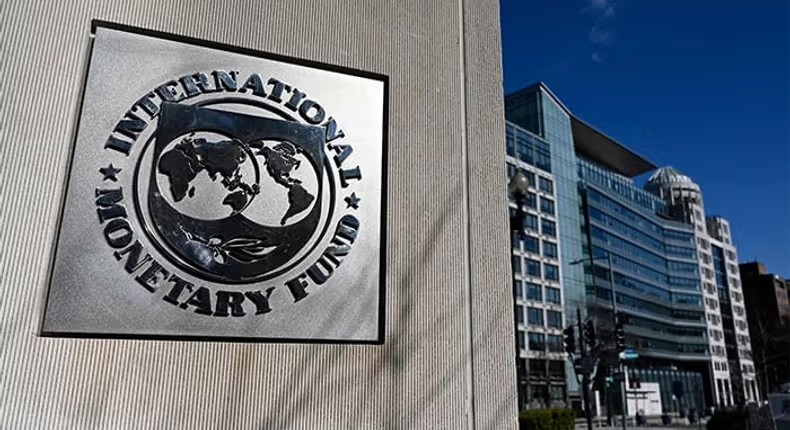
The global financial spotlight is returning to Southern Africa as the International Monetary Fund (IMF) prepares to initiate critical discussions with Lusaka. Starting this April, the Zambia IMF loan program will take center stage once again. These negotiations represent a pivotal moment for a nation that has spent years navigating the turbulent waters of sovereign debt and fiscal reform. While the talks are imminent, the lender has signaled that a final agreement will likely remain on the horizon until late 2024.
This strategic delay is directly tied to the country’s political calendar. The IMF indicated that a formal package is expected to conclude only after the national elections scheduled for August. Consequently, the timing ensures that any new fiscal commitment aligns with the mandate of the incoming administration. President Hakainde Hichilema is widely expected to seek a second term in this upcoming contest. His administration has consistently leaned into international cooperation to stabilize a once-shaky economy.
Understanding the Significance of the Zambia IMF Loan Program
For years, the relationship between Lusaka and Washington has been a barometer for African economic health. The previous financial arrangement, a $1.7 billion facility established in 2022, officially reached its conclusion in January. That program was widely seen as a lifeline. It provided the necessary framework for the country to exit a period of deep financial uncertainty.
The successful completion of that program cleared the path for these new discussions. However, the stakes remain high. A new agreement would provide a continued cushion against global market volatility. Furthermore, it would signal to international investors that the government remains committed to fiscal discipline. This is significant because emerging markets often struggle to maintain investor confidence during election years.
From Default to Debt Restructuring
To understand the weight of these upcoming talks, one must look back at Zambia’s recent history. In 2020, the nation made headlines for a sobering reason. It became the first African country to default on its sovereign debt during the global pandemic era. This default triggered a complex and lengthy restructuring process.
For nearly three years, the government worked under the G20 Common Framework. This was a massive undertaking involving a diverse group of creditors. Last year, Zambia finally concluded major restructuring agreements with all its primary lenders. This achievement was a massive diplomatic and economic win for President Hichilema. It essentially hit the “reset” button on the nation’s creditworthiness.
The Copper Engine: Driving the 2026 Outlook
Beyond the halls of the IMF, the real-world impact of these policies is being felt in the copper belt. Zambia is one of the world’s leading copper producers. This commodity is the lifeblood of its export economy. Recently, the country has seen a significant influx of new mining investment. These capital injections are vital for long-term growth.
Consequently, the country has been able to shore up its foreign exchange reserves. A healthy “forex” cushion protects the local currency from sudden shocks. It also makes it easier for the country to import essential goods and service remaining obligations. The IMF’s outlook for the nation reflects this growing stability. Current projections suggest the economy will expand by 5.5% in 2026.
Why the August Election Matters
Elections frequently introduce an element of risk into macroeconomic planning. By scheduling the conclusion of the Zambia IMF loan program talks after August, the IMF is practicing institutional caution. This move avoids the perception of political interference. It also ensures that the terms of the loan are agreed upon by a government with a fresh five-year mandate.
President Hichilema has made economic recovery the cornerstone of his platform. His supporters point to the debt restructuring as proof of his effectiveness. Meanwhile, critics often focus on the cost of living and the pace of job creation. The outcome of the August vote will determine if the current trajectory continues or if a new fiscal philosophy takes hold.
A New Chapter for Southern African Finance
The transition from a “defaulted nation” to a “growth story” is rarely linear. Zambia’s journey has been marked by rigorous austerity and difficult negotiations. Nevertheless, the start of talks in April suggests that the international community sees potential in the country’s path. The 5.5% growth forecast for 2026 is an ambitious target, but it is supported by the recent mining boom.
If a new package is secured post-August, it will likely focus on several key areas:
-
Strengthening social safety nets for the most vulnerable citizens.
-
Enhancing transparency in public financial management.
-
Supporting the diversification of the economy away from a sole reliance on copper.
-
Improving the business climate to attract further private sector investment.
Furthermore, the successful navigation of these talks could serve as a blueprint for other nations. Several other African countries are currently facing similar debt pressures. A stable and prosperous Zambia would provide a powerful example of how the IMF and local governments can work together effectively.
Final Thoughts on the Road Ahead
As April approaches, all eyes will be on the preliminary meetings between Zambian officials and IMF delegates. These sessions will lay the groundwork for the post-election landscape. While the wait until August may seem long, the focus remains on long-term sustainability rather than quick fixes.
The world is watching to see if Zambia can maintain its momentum. With debt restructuring behind it and mining investment on the rise, the country is positioned for a comeback. The upcoming Zambia IMF loan program is the final piece of the puzzle. It represents a bridge toward the 2026 growth targets and a more resilient future.
_________________________________________________
James Swan Takes the Helm: A New Chapter for the UN MONUSCO Mission in DR Congo