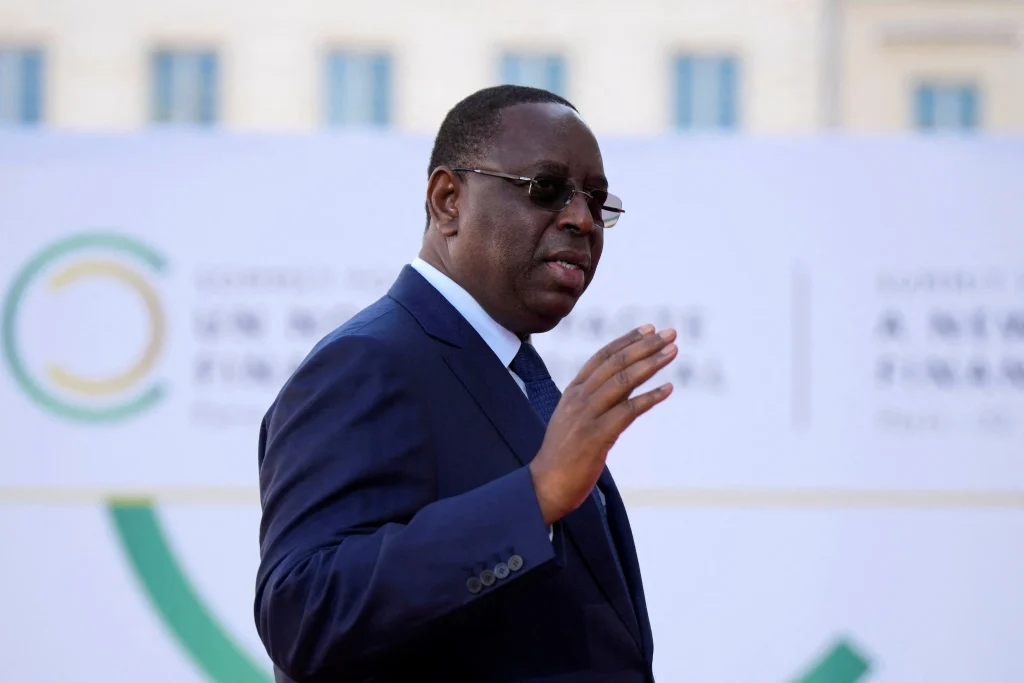
The landscape of international diplomacy is shifting as the United Nations prepares for one of its most consequential leadership transitions in decades. Former Senegalese President Macky Sall has officially entered the race to become the next UN Secretary-General, marking a significant moment for African representation on the global stage.
The United Nations confirmed on Monday that Sall who served as Senegal’s head of state from 2012 to 2024 was formally nominated for the position by Burundi. As the search for a successor to the outgoing chief, Antonio Guterres, intensifies, Sall’s candidacy introduces a seasoned political veteran into a field increasingly defined by regional interests and a historic push for gender diversity.
A Legacy of Leadership and Domestic Debate
Macky Sall’s decade-plus tenure in Senegal provides a complex backdrop for his international ambitions. On the global stage, he has often been viewed as a stabilizing force in West Africa, a region frequently marred by political upheaval and security challenges. During his presidency, Senegal maintained its reputation as a democratic stronghold, and Sall himself played pivotal roles in regional mediation through the Economic Community of West African States (ECOWAS).
However, his path to the UN’s top job is not without friction. Domestically, Sall’s legacy is currently under a microscope. While his administration oversaw significant infrastructure projects and economic growth initiatives, he faces ongoing criticism from political opponents and fiscal watchdogs.
The most prominent accusations involve the transparency of Senegal’s public finances. Critics allege that his administration underreported the national deficit and obscured the true extent of the country’s fiscal health during his final years in office. For a role that requires the highest standards of integrity and financial oversight, these domestic challenges may become a focal point of discussion during the UN selection process.
Understanding the UN Election Process
The election of a Secretary-General is a unique blend of formal procedure and high-stakes geopolitics. The incoming leader will serve a five-year term beginning on January 1, 2027.
Historically, the position has followed an informal regional rotation. However, this tradition is often subject to the shifting alliances of the permanent members of the Security Council. When Antonio Guterres was elected in 2016, many expected an Eastern European candidate to take the helm. Instead, the consensus landed on the former Portuguese Prime Minister.
| Candidate | Country | Current/Former Role |
| Macky Sall | Senegal | Former President |
| Michelle Bachelet | Chile | Former President / Former UN Human Rights Chief |
| Rafael Grossi | Argentina | Director General of the IAEA |
| Rebeca Grynspan | Costa Rica | Former Vice President (Pending formal submission) |
As it stands, the unofficial rotation points toward Latin America as the next region in line. This puts Sall in a competitive position, as he must convince the international community that an African leader is the right fit for the current global climate, regardless of regional “turns.”
The Push for the First Female Secretary-General
One of the most powerful narratives surrounding this election is the demand for a woman to lead the United Nations. In its 80-year history, the UN has never had a female Secretary-General. This has led to a growing international movement—backed by various member states and advocacy groups—to prioritize qualified female candidates.
Sall faces formidable competition from this front. Michelle Bachelet, the former President of Chile and a former UN High Commissioner for Human Rights, brings an immense amount of “UN-insider” experience and global name recognition. Similarly, Rebeca Grynspan, though her formal letter is pending, represents a strong contender with deep roots in international development.
The presence of these high-profile women ensures that the selection process will be more than just a debate over regional rotation; it will be a test of the UN’s commitment to gender equality at the highest levels of power.
The Role of the Security Council
The roadmap to the 38th floor of the UN Secretariat runs directly through the Security Council. The Council must begin its formal selection process by the end of July.
The process typically involves a series of “straw polls” informal, secret ballots where Council members indicate whether they “encourage,” “discourage,” or have “no opinion” on a candidate. This phase is crucial because any of the five permanent members (the P5) can effectively veto a candidate they find unsuitable.
For Macky Sall, the challenge will be navigating the interests of the P5:
- United States and Europe: Will likely focus on his democratic record and fiscal transparency.
- China and Russia: May view his candidacy through the lens of their expanding influence in Africa and his previous stances on non-alignment.
Global Challenges Awaiting the Next Chief
Whoever succeeds Antonio Guterres will inherit a world defined by deep fractures. The next Secretary-General will need to address:
- Climate Change: Managing the disproportionate impact of global warming on the Global South.
- Conflict Resolution: Navigating the gridlock in the Security Council regarding major global wars.
- UN Reform: Addressing long-standing calls to modernize the world body’s structure to better reflect the 21st-century power balance.
Macky Sall’s supporters argue that his experience leading a developing nation gives him a unique perspective on these issues, particularly regarding the debt crises and environmental vulnerabilities facing many UN member states.
Conclusion
Macky Sall’s entry into the race signals that Africa is ready to assert its influence in the halls of global governance. While he brings a resume of executive leadership and regional mediation, he must overcome domestic controversies and a historic tide favoring a female candidate.
As the Security Council prepares to convene in July, the world will be watching to see if the UN chooses a path of regional tradition, gender breakthrough, or political pragmatism. The stakes for the 2027-2032 term could not be higher.
READ ALSO: Diplomatic Breakthrough: Guinea Releases 16 Detained Sierra Leonean Security Officers