
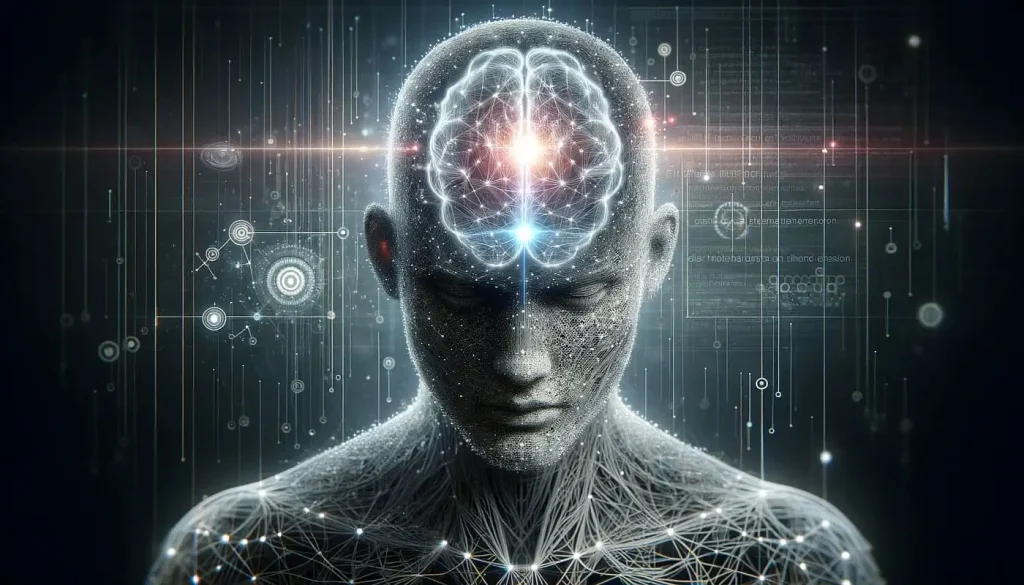
Have you ever wondered how the internet gets it right?
You’re sitting on your couch, merely thinking about that specific pair of vintage Italian leather boots you saw once in a movie. You haven’t searched for them. You haven’t whispered their name to your phone. Yet, ten minutes later, there they are—stalking you in a high-definition Instagram ad. It feels like the digital world has developed a sixth sense.
While that specific phenomenon is usually just a mix of terrifyingly good algorithms and predictive data, we are rapidly approaching a reality where AI won’t need to guess what you’re thinking. It will simply read it.
The Science of Digital Telepathy
For decades, the idea of “reading thoughts” was relegated to the realms of science fiction and tinfoil hats. But in the last few years, a field known as Functional Magnetic Resonance Imaging (fMRI) combined with Large Language Models (LLMs) has turned fiction into fact.
Researchers at the University of Texas at Austin recently developed a system called a semantic decoder. Here’s how the magic happens:
- The Brain Scan: A person sits in an fMRI machine and listens to a story or imagines telling one.
- The Translation: The machine monitors blood flow in the brain, capturing the “chatter” of neurons.
- The AI Interpretation: An AI model (similar to the tech behind ChatGPT) analyzes those scans and translates the brain activity into actual text.
The result? The AI can reconstruct the gist of your thoughts in real-time. If you’re thinking, “I need to go for a walk by the river,” the AI might output, “The person wants to exercise near the water.” It’s not word-for-word yet, but the “vibe” is unmistakable.
From “Thinking” to “Seeing”
It’s not just words, either. AI is beginning to reconstruct visual thoughts.
In 2023, researchers in Japan used a model called Stable Diffusion to reconstruct images from human brain activity. Participants were shown photos of landscapes or objects while their brains were scanned. The AI then “painted” what it saw in the participant’s mind.
While the images were slightly blurry like a half-remembered dream they were undeniably accurate. If a participant looked at a clock tower, the AI produced a tower with a clock face. We are, quite literally, projecting our internal movies onto external screens.
The “Superpower” vs. The “Shadow”
Like every major leap in technology, AI mind-reading is a double-edged sword.
The Superpower: Giving a Voice to the Voiceless
The most beautiful application of this tech lies in assistive communication. For individuals with “locked-in syndrome,” paralysis, or non-verbal autism, this isn’t a privacy threat—it’s a liberation. AI decoders can act as a bridge, allowing people who cannot move or speak to communicate their needs, feelings, and stories to the world through thought alone.
The Shadow: The Death of the “Inner Sanctum”
On the flip side, we have to talk about Cognitive Liberty. Up until now, your mind was the only place on Earth that was truly private. You could be in a crowded room or a high-security prison, and your thoughts would still be yours.
If AI can decode your intentions, your political leanings, or your secrets just by looking at your brain waves, what happens to the concept of a “private life”? Could future employers “scan” for loyalty? Could governments monitor for “wrongthink”?
Can You Block the Mind-Reader?
The good news? Your brain is still remarkably “stubborn.” Current AI mind-reading requires the user’s active cooperation. In the Texas study, if participants told themselves a different story or thought about something else while the AI tried to decode them, the machine failed completely.
Your mental privacy is currently protected by your own focus. But as sensors become more portable—think “smart headbands” or neural-link implants—the barrier between the “inside” and the “outside” will continue to thin.
Conclusion: The Future of Being Human
We are entering an era where the phrase “I know what you’re thinking” is no longer a figure of speech. AI is decoding the electrical symphony of our consciousness, turning silent thoughts into data points.
It’s a world that promises to heal the broken and connect the isolated, but it also demands that we build new digital “walls” around our gray matter. One thing is for certain: the next time you see that strangely accurate ad on your phone, you might find yourself wondering if the machine is just guessing—or if it’s finally started listening to your silence.
If AI could read your mind right now, what would it see? A brilliant idea, a hidden worry, or just a craving for coffee? Drop a comment below and tell us: South Africa Debt Stabilizes After 17 Years: What This Massive Turnaround Means