A severely ill man appeared inside a Nigerian courtroom this Thursday. His failing health immediately sparked a desperate legal maneuver. The defendant recently suffered a debilitating stroke. Consequently, his defense team pleaded for immediate medical intervention.
However, this isolated legal proceeding is not happening in a vacuum. It is unfolding under a massive geopolitical microscope. The courtroom drama sits at the exact center of escalating US-Nigeria religious freedom disputes.
Defense lawyer Ibrahim Angulu stood before the judge with two urgent applications. First, he challenged the duplicate charges filed against his client. Second, he desperately sought bail for the primary defendant.
Angulu pointed directly to his client’s deteriorating physical condition.
“As you can see, the first defendant has suffered a stroke. So, on compassionate grounds, we are asking the court to allow him to be treated in a hospital instead of just lying in prison,” Angulu stated.
Meanwhile, thousands of miles away in Washington, intense diplomatic negotiations were underway. This localized push for compassionate bail mirrors a broader international debate regarding basic human rights.
The Core of US-Nigeria Religious Freedom Debates
The United States government recently took a drastic diplomatic step. Washington officially designated Nigeria as a “Country of Particular Concern.”
This severe classification acts as a diplomatic blacklist. It specifically targets nations accused of systemic and egregious human rights violations. In this instance, Washington cited severe allegations of Christian persecution.
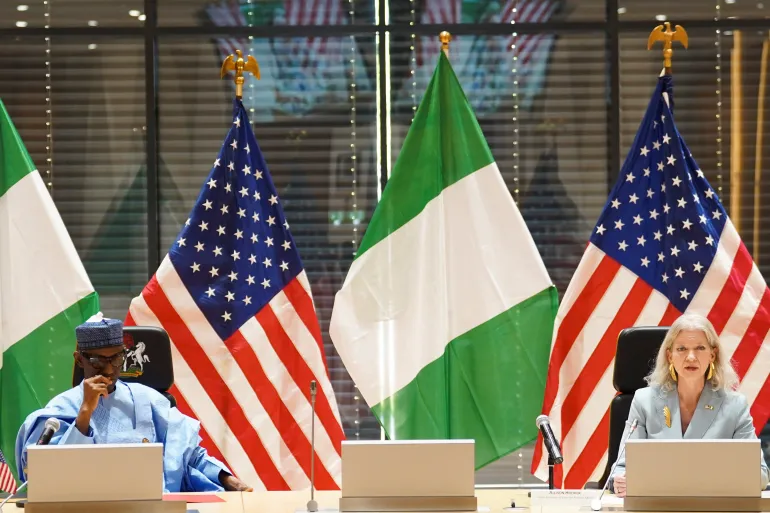
Consequently, a highly specialized US-Nigeria joint working group is currently meeting. These high-level discussions follow intense talks initiated in January.
The State Department is applying immense pressure on Abuja. American officials view the violence through a strict sectarian lens.
Following the January negotiations, State Department official Allison Hooker made Washington’s stance perfectly clear. She bluntly stated that Nigeria “must do more to protect Christians.”
Notably, Hooker entirely omitted any mention of Muslim victims in her public remarks.
This specific framing infuriates many Nigerian officials. It also frustrates independent geopolitical analysts. Experts argue that Washington’s sectarian narrative dangerously oversimplifies a complex crisis.
Furthermore, analysts completely reject the premise of state-sponsored religious persecution. Instead, they point to a much broader systemic collapse.
Experts attribute the widespread violence to several intersecting, non-religious factors:
-
A catastrophic failure of state security infrastructure.
-
The unchecked proliferation of heavily armed bandit groups.
-
Deadly resource competition driven by severe climate change.
-
Decades of economic marginalization in rural territories.
Bandits in Nigeria’s northwest routinely slaughter Muslims and Christians alike. Therefore, framing the violence solely as religious persecution misrepresents the reality on the ground.
How US-Nigeria Religious Freedom Pressure Impacts Military Strategy
Despite the friction, Nigerian President Bola Tinubu is playing a highly strategic game. He is actively leveraging this immense diplomatic pressure.
Tinubu is using Washington’s human rights concerns to extract massive concessions. He has successfully transformed this diplomatic friction into increased military cooperation.
The Nigerian military is currently overwhelmed. Armed groups control vast swathes of rural territory. Consequently, Abuja desperately requires advanced tactical support.
Washington has cautiously agreed to expand its military footprint. Recent cooperative efforts include direct US tactical strikes in Nigeria’s volatile northwest region.
Furthermore, the United States has expanded its troop training programs for Nigerian forces.
This military alliance serves dual purposes. First, it helps Tinubu combat domestic insurgencies. Second, it allows the United States to maintain a crucial strategic foothold in West Africa.
The Sahel region is rapidly destabilizing. Several neighboring countries have recently experienced violent military coups. Therefore, Washington desperately needs a stable security partner in the region.
However, this pragmatic military alliance is sparking fierce blowback back in Washington.
Lawmakers Rebel Against US-Nigeria Religious Freedom Policies
While the State Department negotiates, some American lawmakers are actively revolting. They remain deeply skeptical of Nigeria’s commitment to basic human rights.
Representative Chris Smith is leading this vocal congressional opposition. He outright rejects the State Department’s pragmatic approach to Abuja.
Smith recently leveled severe accusations directly at the Nigerian government. He publicly accused Abuja of harboring a dangerous “culture of denial” regarding the ongoing violence.
Consequently, Smith took a highly visible stand this month. He intentionally boycotted a high-profile diplomatic event.
The congressman pointedly declined a formal dinner invitation with Nigerian First Lady Remi Tinubu. He dismissed the diplomatic gathering entirely, labeling it a mere “photo op.”
This high-profile snub highlights a fractured American foreign policy. The executive branch seeks military cooperation. Meanwhile, the legislative branch demands immediate humanitarian accountability.
Ultimately, the sick defendant lying in a Nigerian prison cell represents a much larger tragedy. He is caught in a failing justice system.
Simultaneously, two allied nations remain deadlocked. They cannot even agree on the fundamental causes of the violence destroying thousands of lives. Until Washington and Abuja align their perspectives, the bloodshed will undoubtedly continue.
______________________________________________________