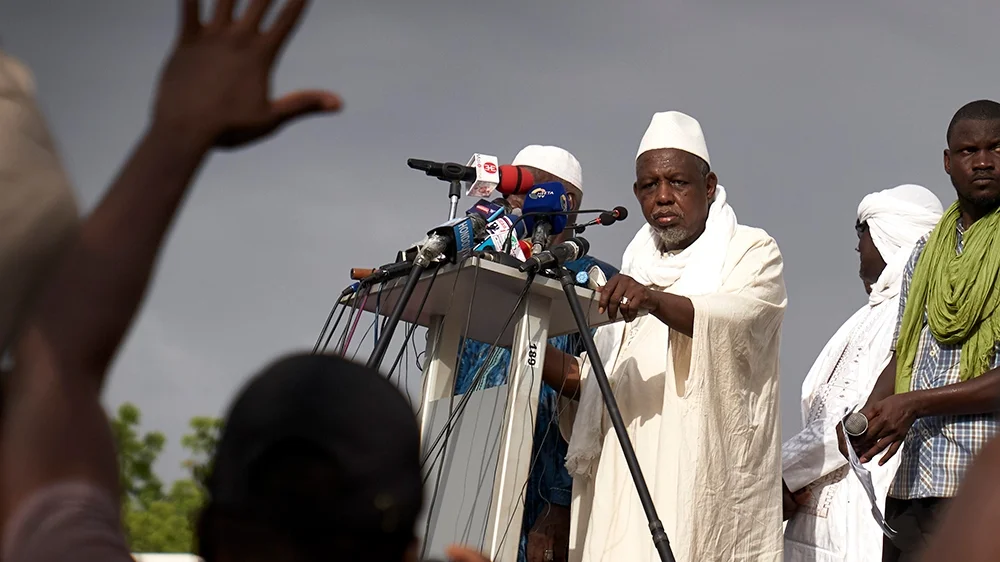
On Thursday, February 12, 2026, one of West Africa’s most influential religious and political figures, Imam Mahmoud Dicko, issued a stirring plea for peace. Speaking from his place of exile in Algeria, the prominent Malian leader urged an immediate cessation of the jihadist violence that has crippled the Sahel region for more than ten years.
Dicko’s address highlighted the desperate need for a coordinated, unified response to a crisis that transcends national borders. “We must find a solution for the entire sub-region,” Dicko stated. His message emphasized that the security threats facing West Africa are deeply interconnected and cannot be solved by any single nation acting in isolation.
A Decade of Conflict: The Epicenter of Global Jihadism
For the past decade, the “Liptako-Gourma” tri-state border region—encompassing Burkina Faso, Mali, and Niger—has remained the global epicenter of extremist activity. These nations have faced unrelenting pressure from insurgent groups affiliated with Al-Qaeda and the Islamic State (IS).
The human cost of this decade-long war is staggering:
- Casualties: Tens of thousands of civilians and soldiers have lost their lives.
- Displacement: Over 3 million people have been forced to flee their homes, creating a massive humanitarian crisis.
- Instability: Constant insecurity has led to the collapse of state services, including education and healthcare, in rural areas.
This persistent violence has fundamentally reshaped the political landscape of the Sahel. Frustrated by the inability of elected governments to stem the tide of insurgency, military officers seized power through successive coups in all three nations. These military juntas now govern with a mandate of “security first,” often at the expense of traditional democratic norms.
The Geopolitical Pivot: France Out, Russia In
One of the most profound shifts in 2026 is the total transformation of international security alliances in the Sahel. For years, the French military served as the primary counter-terrorism partner for Bamako, Niamey, and Ouagadougou. However, that era has officially ended.
Current military leaders have expelled French forces, accusing the former colonial power of failing to defeat the jihadist threat and infringing upon national sovereignty. In a dramatic geopolitical pivot, these juntas have turned toward Russia for military support.
International analysts are closely monitoring the impact of this transition. The arrival of Russian security advisors and private military contractors has altered the tactical approach to the conflict, focusing more on aggressive “clearing” operations. However, critics argue that this shift has not yet resulted in long-term territorial stability.
Who is Mahmoud Dicko? The “Kingmaker” of Mali
To understand the weight of Thursday’s appeal, one must understand the unique stature of Mahmoud Dicko. He is not merely a religious leader; he is a veteran political strategist who has shaped the fate of the Malian state for over two decades.
Key Milestones in Dicko’s Career:
| Role | Impact |
| High Islamic Council | Served as President, uniting diverse religious factions in Mali. |
| Political Kingmaker | Inspired the 2020 protest movement that led to the ousting of President Ibrahim Boubacar Keita. |
| Bridge Builder | Has historically acted as a mediator between the state and armed groups in the north. |
| Exiled Critic | Moved to Algeria in 2023 after falling out with the current military transition leaders. |
Dicko’s ability to mobilize thousands of followers in the streets of Bamako makes him a figure that both politicians and generals must respect—or fear. His current status as an exile in Algeria allows him to speak freely, but it also physically distances him from the center of power.
Beyond the Gun: Seeking a Sub-Regional Solution
Dicko’s latest intervention is a direct challenge to the “military-only” approach currently favored by the Sahelian juntas. By calling for a “sub-regional solution,” he is advocating for a return to diplomacy and a focus on the root causes of extremism: poverty, lack of justice, and social exclusion.
He argues that a purely kinetic response—relying on drones and special forces—will never fully defeat an ideology. Instead, he proposes:
- Ideological Engagement: Countering extremist narratives with moderate religious teaching.
- Regional Coordination: Harmonizing the security and trade policies of the Alliance of Sahel States (AES).
- Community Dialogue: Re-engaging with local leaders in the border regions who feel abandoned by the central governments.
Conclusion: A Voice of Caution from Abroad
As the Sahel prepares for another year of uncertainty in 2026, Mahmoud Dicko’s voice serves as a sober reminder of the human stakes. While the military juntas in Mali, Niger, and Burkina Faso emphasize sovereignty and force, Dicko is reminding the world that peace requires more than just weapons.
The people of the Sahel remain caught between the brutality of jihadist groups and the stern rule of military regimes. Whether the current leaders in Bamako will listen to their former ally remains to be seen. However, as Dicko rightly notes, the clock is ticking for a region that has known little but war for a decade.
READ ALSO: Egypt Bolsters Somalia Security Mission: Troops Prepare for 2026 Deployment