Egypt has intensified its military commitment to the Horn of Africa. Specialized troop units recently completed rigorous training for deployment to Somalia. This move marks a pivotal shift in regional security as Cairo joins the African Union Support and Stabilization Mission in Somalia (AUSSOM).
On Wednesday, February 11, 2026, Somali President Hassan Sheikh Mohamud and Egyptian Minister of Defence General Abdel Mageed Saqr inspected the forces. The ceremony, held in Egypt, showcased the advanced combat readiness of units tasked with stabilizing a nation battling decades of insurgency.
A New Chapter: Transitioning to AUSSOM
The deployment comes at a critical time for Somali security. Following the conclusion of the African Union Transition Mission (ATMIS) in late 2024, the international community moved toward a more strategic framework.
AUSSOM became effective on January 1, 2025. Its focused mandate is to:
- Degrade Al-Shabaab: Weakening the capabilities of the extremist group.
- Handover Security: Facilitating the gradual transfer of responsibility to the Somali National Army.
To ensure success, the UN Security Council recently adopted Resolution 2809. This extends the mission’s authorization until December 31, 2026. The extension shows that while progress has been made, extremist factions remain a hurdle to regional peace.
Showcasing Military Might and Readiness
The inspection by President Mohamud and General Saqr demonstrated Egypt’s sophisticated military capabilities. These units underwent training for unique challenges like urban warfare, counter-insurgency, and rural stabilization.
Equipment Designated for the Mission:
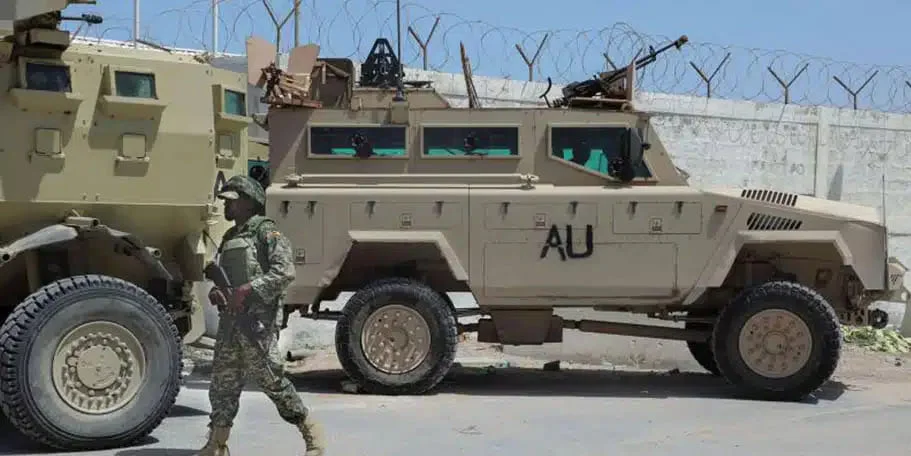
- Armored Mobility: The deployment includes RG-33L 6×6 MRAPs and BAE Caiman units to protect against IEDs.
- Air Support: Egypt is providing Mil Mi-24 Hind gunships and Mil Mi-17 utility helicopters.
- Surveillance: The mission will use AT-802i Air Tractor aircraft for intelligence and reconnaissance (ISR).
General Saqr emphasized that the Egyptian Armed Forces bring “expert knowledge and tactical proficiency” to support Mogadishu’s institutions.
Geopolitical Tensions: Somaliland and Ethiopia
Egypt’s entry is a strategic move influenced by regional shifts. In late 2025, the diplomatic climate grew complex after Israel’s recognition of Somaliland.
Somalia rejects Somaliland’s claims of independence, viewing recognition as a violation of territorial integrity. For Cairo, these shifts and tensions between Somalia and Ethiopia—have sparked concerns about influence near the Red Sea.
Strategic Objectives for Cairo:
- Protecting the Red Sea: Stability in the Gulf of Aden is a top priority for Egypt and the Suez Canal.
- Counter-Terrorism: Preventing the expansion of Al-Shabaab to ensure extremism does not spill into the Middle East.
- Regional Leadership: Reasserting Egypt’s role as a security guarantor for African partners.
The Road Ahead for AUSSOM in 2026
As the mission enters its second year under AUSSOM, the goal is clear: the total degradation of Al-Shabaab. While the group has lost territory, it can still launch attacks in the capital and along supply routes.
Egyptian units provide vital logistical and technical support. However, funding sustainability remains a challenge. UN officials note a liquidity gap in the mission’s budget. They are calling on donors to honor commitments to ensure equipment maintenance through the end of the 2026 mandate.
Conclusion: A Stand for Sovereignty
Egypt’s presence represents a commitment to African-led peace. By stabilizing Somalia, Cairo sends a message: Somalia’s territorial integrity is a pillar of regional stability. As the first wave of troops prepares to land, the region remains hopeful for a future free from terrorism.
READ MORE: Tottenham Hotspur Dismiss Thomas Frank Following Defeat to Newcastle