
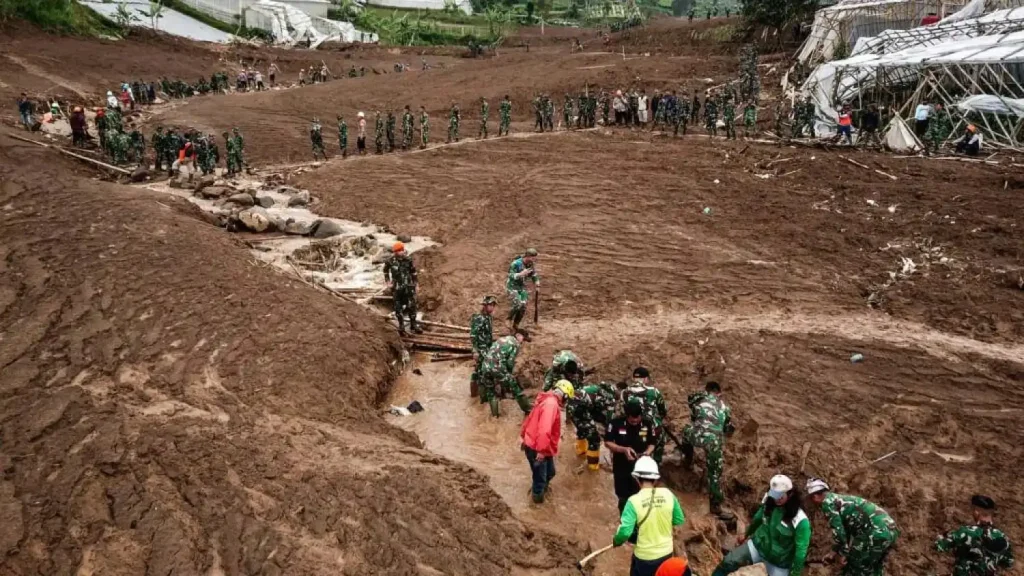
The official death toll from the catastrophic landslide in West Java has climbed to 74, authorities confirmed on Friday, February 6, 2026. This grim update arrives nearly two weeks after the initial disaster, as exhausted search teams continue to pull victims from the shifting, rain-soaked terrain. While the initial hope of finding survivors has largely faded into mourning, the mission has now transitioned into a critical and massive recovery phase.
Rescuers remain focused on providing closure to hundreds of families who still have loved ones listed on the missing persons registry. The scale of the tragedy in the West Bandung region has once again highlighted Indonesia’s extreme vulnerability to seasonal weather patterns and the accelerating pace of environmental degradation.
The Disaster: 14 Days of Toil in Pasirlangu Village
The catastrophe began on January 24, 2026, following a period of relentless, torrential rainfall that saturated the volcanic soil of the region. The mountainside finally gave way, sending a massive wall of mud, boulders, and uprooted debris crashing into Pasirlangu village. The sheer force of the slide was so immense that it obliterated approximately 50 homes in mere seconds, leaving residents with almost no time to reach higher ground.
Since the first hours of the disaster, a massive mobilization of human resources has been underway. Thousands of rescuers have descended on the site, including:
- The Indonesian Military (TNI): Providing heavy logistics and manpower.
- National Police (Polri): Assisting in victim identification and security.
- Local Search and Rescue (BASARNAS) teams: Leading the technical recovery.
- Specialized Volunteer Units: Local groups familiar with the mountain paths.
Despite the arrival of heavy excavators and industrial equipment, much of the work in the immediate aftermath was conducted by hand. The thick, viscous nature of the mud makes heavy machinery prone to getting stuck or even triggering secondary slides. This has forced personnel to use shovels and their bare hands to clear the wreckage of buried households, a grueling process that has lasted for 14 consecutive days.
Military Casualties: A Double Tragedy in the Mud
Among the most heartbreaking aspects of this disaster is the loss of specialized military personnel. The Indonesian Navy confirmed on Friday that 23 of its members were caught in the landslide. These personnel were reportedly conducting routine training exercises in the Pasirlangu area when the slope collapsed.
Their presence in the village was intended to be temporary, yet they became part of the very disaster they are often trained to assist with. The recovery of these servicemen has become a high priority for the military, adding a layer of professional mourning to the national grief. This incident underscores the unpredictable nature of landslide events, which can strike even those who are highly trained in situational awareness.
Environmental Context: The Deforestation Link
The Indonesian government is increasingly pointing to a “man-made” catalyst for these natural disasters: massive forest loss. While landslides are a recurring feature of the October-to-March rainy season in Java, their frequency and lethality have surged alongside the thinning of the island’s tropical canopy.
Why Forests Matter for Slope Stability
Trees and dense vegetation act as the primary defense against earth movements in three distinct and vital ways:
- Hydraulic Regulation: Tree canopies intercept rainfall, slowing its impact on the ground. Roots then absorb vast quantities of water, preventing the soil from reaching its “liquid limit”—the point where solid earth turns into flowing sludge.
- Structural Anchoring: Deep and complex root systems weave through the soil and into the bedrock, effectively “stapling” the earth to the mountain. Without these anchors, the topsoil sits loosely on the rock like a carpet on a tilted floor.
- Soil Cohesion: Decaying organic matter from forests creates a soil structure that is more porous and stable. In contrast, deforested areas often feature compacted earth that cannot absorb water, leading to rapid surface runoff and erosion.
The government referenced a similar disaster in Sumatra late last year that killed 1,200 people. In that instance, forensic environmental audits confirmed that over 40% of the affected hillside had been cleared for illegal agriculture and logging. As forest cover disappears, the mountains of the Indonesian archipelago are essentially losing their “skeletons,” leaving them at the mercy of the elements.
Current Challenges: Visibility and Unstable Ground
The recovery phase is proving to be just as dangerous as the initial rescue attempt. Ade Dian Permana, head of the local search and rescue agency, noted that environmental conditions remain the greatest adversary to the teams on the ground.
“Weather conditions remain the main challenge, with thick fog and rain still covering the search area,” Ade reported on Friday. The fog in the West Bandung mountains can reduce visibility to less than five meters, making the operation of heavy machinery extremely risky for both the operators and the personnel working in the pits below.
Furthermore, the ground remains “active.” Every new rain shower threatens to trigger secondary slides, which could trap the rescuers themselves. Currently, over 160 residents remain displaced, living in overcrowded temporary shelters. They wait in agonizing silence for word on their missing relatives, knowing that each passing hour makes the recovery of identifiable remains more difficult.
A Call for Structural Change and Green Zones
As the search in Pasirlangu enters its final days, the focus in Jakarta is shifting toward prevention. Disasters like this cost the Indonesian economy billions of rupiah each year in lost infrastructure, emergency response, and long-term aid.
Authorities are now discussing the following structural changes:
- Stricter Enforcement of “Green Zones”: Banning all construction and farming on slopes with a gradient higher than 30 degrees.
- Reforestation Initiatives: Planting deep-rooted native species in high-risk zones.
- Early Warning Systems: Installing soil-moisture sensors that can trigger village-wide alarms before a slide occurs.
However, for the survivors in West Bandung, these policy discussions come too late. Their homes are gone, their livelihoods are buried under ten feet of mud, and 74 of their neighbors, friends, and family members are dead. The tragedy of Pasirlangu serves as a stark reminder that the cost of environmental neglect is often paid in human lives.
READ ALSO: New Zealand’s 2026 Wage Hike: New Minimum Standard Set for April