
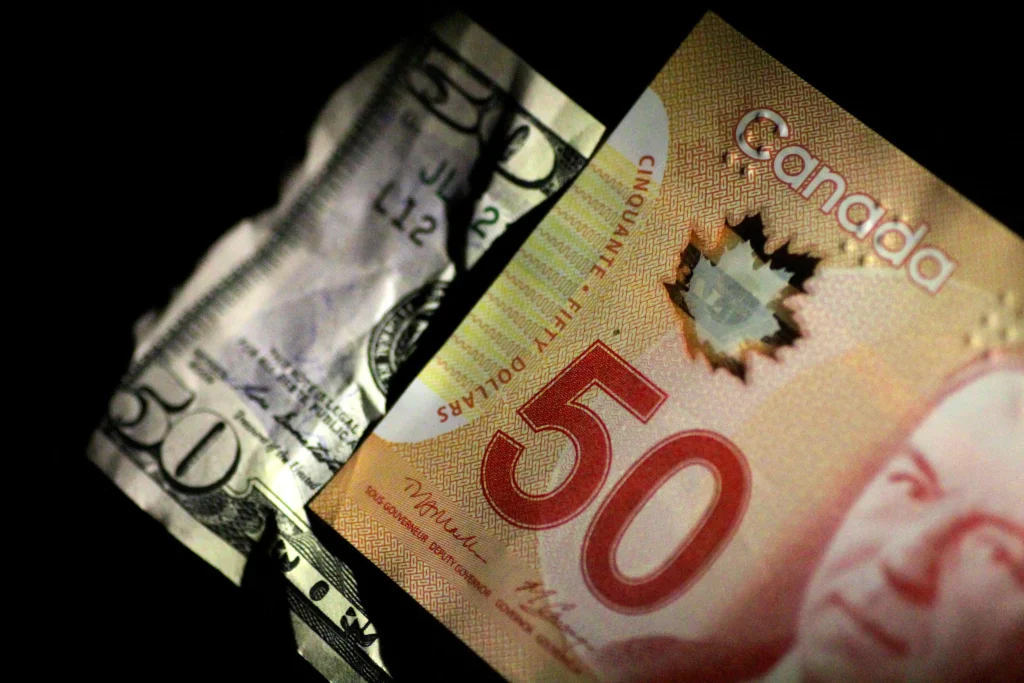
The Canadian dollar (CAD) experienced a notable decline against its U.S. counterpart on Wednesday, February 4, 2026. This downward movement was fueled by a potent combination of a strengthening U.S. greenback and a series of disappointing domestic economic indicators that signaled deepening cracks in the Canadian economy.
The “loonie” fell by approximately 0.2%, settling around 1.3670 per U.S. dollar, or 73.15 U.S. cents. Throughout the trading session, the currency fluctuated within a range of 1.3629 to 1.3684, reflecting a market that is increasingly cautious about Canada’s near-term growth prospects.
A Deepening Downturn: Services Sector Under Pressure
The primary catalyst for the domestic sell-off was fresh data from S&P Global, which painted a grim picture of Canada’s services economy. The Business Activity Index—a key metric for measuring the health of the services sector—fell to 45.8 in January. This is a significant drop from December’s reading of 46.5.
Because a reading below 50.0 indicates contraction, this latest data confirms that the services sector has now been shrinking for three consecutive months. Analysts point to persistent “trade uncertainty” as a primary driver for this decline. This uncertainty has dampened new business ventures and suppressed overall economic activity across the country.
Why the Services Sector Matters
The services industry represents a massive portion of Canada’s GDP. When this sector stalls, the ripple effects are felt throughout the labor market and consumer spending. Furthermore, the decline in “new business” suggests that companies are hesitant to invest, likely due to shifting geopolitical trade relations and high borrowing costs that characterized the start of 2026.
The Housing Market: Toronto’s Sharp Decline
Adding to the economic “gloom” is the state of the Canadian real estate market. New data revealed that home sales in the Greater Toronto Area (GTA)—Canada’s most populous and economically vital region fell sharply in January.
The decline in sales was the most severe witnessed in 11 months. Accompanying this drop in volume was a corresponding slide in property prices. For the Canadian dollar, this is particularly concerning because the housing market is often viewed as a proxy for consumer wealth. When home equity decreases, consumer confidence usually follows, leading to lower domestic demand and a weaker currency.
The Greenback’s Surge: The “Warsh Effect”
While Canadian data provided the “push,” the U.S. dollar provided the “pull.” The U.S. Dollar Index (.DXY) posted broad-based gains on Wednesday, extending a rally that began earlier in the year.
Market sentiment in the United States has been significantly bolstered by political shifts in Washington. Specifically, President Donald Trump’s selection of former Federal Reserve Governor Kevin Warsh to lead the central bank as the next Fed chair has sent ripples through the forex markets. Investors interpret this move as a signal for a stable, perhaps more hawkish, monetary policy, which naturally strengthens the U.S. dollar against its peers.
Technical Analysis: Will the Loonie Break 1.37?
From a technical perspective, many market experts view the current slide of the Canadian dollar as a “recalibration.” Marc Chandler, Chief Market Strategist at Bannockburn Global Forex LLC, suggests that the USD-CAD pair still has room to climb.
“There is really only one driver right now, and that is about market positioning and basically a technical correction after the big leg down we had,” Chandler stated. “I think that means that dollar-Canada has got more room to go. If we get above 1.37, we go up to 1.3750–60. The momentum indicators are only just turning.”
Key Technical Levels to Watch
The market is currently focused on several critical milestones. The 1.3629 level stands as recent support; a break below this could signal a temporary CAD recovery. Meanwhile, 1.3670 serves as the current pivot and the immediate battleground for bulls and bears.
Higher up, 1.3700 represents a significant psychological resistance. A break above this level often triggers automated “buy” orders for the USD, potentially propelling the pair toward the next major ceiling at 1.3750.
Speculative Positioning and Bond Yields
Interestingly, despite the current weakness, professional speculators have been hedging their bets. Data from the U.S. Commodity Futures Trading Commission shows that “bearish” bets against the Canadian dollar have reached their lowest levels in nearly two years. This suggests that while the currency is currently down, some institutional investors are wary of betting too heavily on a total collapse.
In the bond market, the Canadian 10-year yield eased slightly, dropping 1 basis point to 3.435%. This followed a four-week intraday high of 3.466% reached on Tuesday. The cooling of yields suggests that bond investors are pricing in a slower economic environment, which aligns with the poor PMI data.
Looking Ahead: The Friday Jobs Report
All eyes are now fixed on Friday’s employment data for January. This report will be the next major catalyst for the Canadian dollar. Economists are currently forecasting a modest gain of 5,000 jobs.
However, many analysts believe the “headline risk” of the jobs report may be secondary to the broader trend. As Marc Chandler noted, the market has a “deep conviction” that the Bank of Canada will remain on hold for at least the next six months. If the jobs data comes in significantly weaker than the 5,000-job forecast, it could force the Bank of Canada to consider rate cuts earlier than expected, putting further downward pressure on the loonie.
Conclusion: A Challenging Path for the CAD
As we move deeper into February 2026, the Canadian dollar faces a difficult path. Between a contracting services sector, a cooling housing market in Toronto, and a resurgent U.S. dollar backed by new Fed leadership, the “loonie” is stuck in a defensive posture. Traders should remain alert to the 1.3700 level; a sustained break above that mark could signal a new period of prolonged weakness for the Canadian currency.