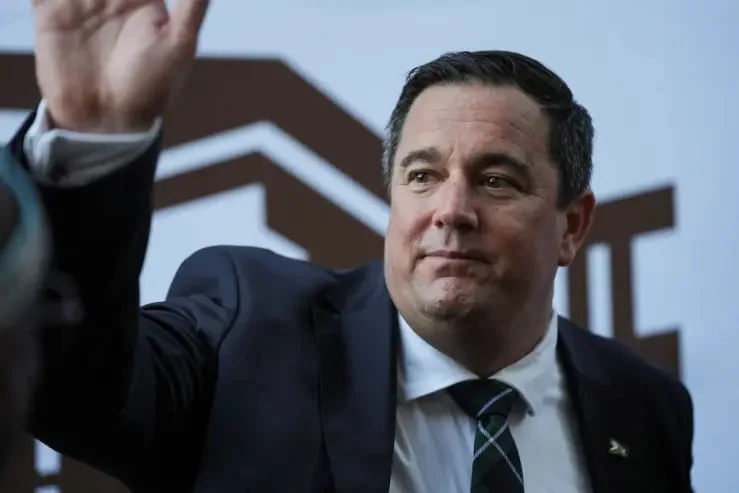
In a move that has sent shockwaves through South Africa’s political landscape, John Steenhuisen announced on Tuesday, February 3, 2026, that he will not seek re-election as the leader of the Democratic Alliance (DA).
The decision comes just months before the party’s federal congress in April. This sudden withdrawal raises immediate questions about the future of the nation’s fragile coalition government and the stability of the Government of National Unity (GNU).
Steenhuisen, 49, currently serves as the Minister of Agriculture. His departure from the helm of the country’s second-largest party marks the end of a leadership tenure that began in 2019.
Under his watch, the DA achieved a historic milestone by entering national government for the first time since the dawn of democracy. However, his exit also signals a period of internal transition as the party prepares for high-stakes local government elections later this year.
A Pivot to Agriculture Amid National Crisis
During a press conference held in eThekwini, Steenhuisen stated that his primary motivation for stepping aside is to focus entirely on his ministerial duties. Specifically, he cited the need to combat a relentless foot-and-mouth disease (FMD) outbreak. This disease has devastated the livestock industry across seven of South Africa’s nine provinces.
“For the rest of this term of office, I will focus all of my time and energy as Minister of Agriculture on defeating the most devastating foot-and-mouth disease outbreak our country has ever seen,” Steenhuisen told reporters.
The FMD crisis has been a major point of criticism for Steenhuisen’s department. The virus causes painful blisters in the mouths and on the hooves of cattle, leading to lameness and permanent reductions in value. In the dairy sector, the disease can cause total loss of milk yields. Farmers have recently labeled the ministry an “obstacle” rather than a solution, criticizing the slow rollout of vaccines and perceived failures in movement control.
Controversies and Internal Friction
While Steenhuisen was previously expected to run for the leadership unopposed, mounting internal and external pressures clouded his path. Sources within the party suggest that several factors influenced his decision to withdraw:
- Credit Card Allegations: In early 2026, Steenhuisen faced an internal probe regarding the alleged misuse of a party-issued credit card. Although the DA’s Federal Executive officially cleared him in January 2026, the investigation revealed that limited personal expenses had been charged to the card. While these were reimbursed, the resulting disciplinary inquiry caused significant internal damage.
- The Dion George Fallout: A high-profile public fallout with the former Minister of Environment, Dion George, further strained Steenhuisen’s standing. George, who resigned in November 2025, alleged that Steenhuisen had orchestrated his removal to protect commercial interests in the captive lion breeding industry. Steenhuisen has dismissed these claims as baseless, but the controversy has lingered.
- Livestock Management Failures: The persistence of the FMD outbreak, particularly in KwaZulu-Natal, has drawn sharp rebukes. With over 200 unresolved outbreaks and a massive vaccination drive only just commencing in February 2026, his political rivals have used the crisis to question his executive competence.
Impact on the Coalition Government
Steenhuisen was a central figure in the historic “marriage of convenience” formed after the 2024 national elections. For the first time since 1994, the African National Congress (ANC) lost its outright parliamentary majority, forcing it to seek partners. Steenhuisen’s leadership was pivotal in negotiating the “Moonshot Pact” and the subsequent formation of the 10-party GNU.
The DA has traditionally drawn its core support from South Africa’s white minority. This group represents approximately 7.3% of the national population (roughly 4.5 million people). However, the party has consistently sought to expand its appeal among the black majority, which constitutes about 81% of the population. Steenhuisen’s ability to navigate the ideological gap between the pro-business DA and the ANC’s more interventionist policies was crucial to the coalition’s inception.
The Search for a Successor
As of early February, the race to succeed Steenhuisen is wide open. While no candidates have officially declared, speculation has centered on Cape Town Mayor Geordin Hill-Lewis.
Hill-Lewis, 39, is widely seen as the frontrunner. He has earned praise for his management of Cape Town, which many regard as South Africa’s best-run metropolitan area. Although he is a close ally of Steenhuisen, the mayor has recently signaled his intention to contest the top post. Other potential contenders include:
- Solly Malatsi: The current Minister of Communications.
- Siviwe Gwarube: The Minister of Basic Education.
Both Malatsi and Gwarube represent a younger, more diverse generation of DA leadership. Their leadership could help the party shed its “white-only” perception and appeal to a broader demographic ahead of the local polls.
Conclusion: A Changing Tide
John Steenhuisen’s exit marks a pivotal moment for the Democratic Alliance. Over his six-year tenure, he successfully steered the party from the opposition benches into the heart of the national executive. However, the weight of the agricultural crisis and internal party disputes has ultimately led to a change in guard.
Whether the party chooses a successor who will maintain the current coalition or steer the party toward a more independent “opposition-first” path remains to be seen. For now, the nation’s focus shifts to the upcoming April congress and Steenhuisen’s high-stakes battle against a viral outbreak that threatens South Africa’s R80 billion livestock industry.
Do you believe the party should choose a successor who will double down on the ANC coalition, or is it time for the DA to return to its roots as a pure opposition force? Comment your take below!