On Tuesday, February 3, 2026, a firing squad in the city of Galkayo carried out a sentence that resonated across the entire Somali peninsula. The execution of Hodan Mohamud Diiriye, 34, was far more than just the legal conclusion of a murder trial. It represented a watershed moment for a justice system operating under intense public and international scrutiny.
The rare decision to execute a woman—the first such instance in the semi-autonomous region of Puntland in over a decade—follows the horrific torture and killing of a 14-year-old orphan, Saabirin Saylaan. Her story has become a powerful catalyst for a long-overdue national conversation. Today, Somalia is confronting the safety of domestic workers and the often-hidden epidemic of child abuse that exists within its borders.
The Victim: A Life Defined by Vulnerability
Saabirin Saylaan’s life was marked by profound tragedy long before she ever stepped foot into the home of her killer. She became an orphan at just one year old, losing both of her parents within a very short period. Consequently, she was raised by various extended family members in a system of informal care common in the region.
In late 2025, a relative made a decision that would prove fatal. They agreed to let Saabirin work as a domestic helper for Diiriye’s family. At the time, the family believed this arrangement would provide the teenager with a stable environment and a way to support herself. Instead, the two months Saabirin spent in that household transformed into a living nightmare.
Police investigations conducted after her death revealed a harrowing pattern of “routine physical abuse.” The evidence proved that the young girl was subjected to systematic torture, a reality far removed from the “home help” role her guardians had envisioned. Her vulnerability as an orphan with no immediate parents to protect her made her an easy target for an unrestricted abuser.
The Evidence That Shocked a Nation
What began as a standard murder investigation quickly evolved into a national scandal. This shift occurred when police recovered digital evidence from Diiriye’s mobile phone. The device contained a “chamber of horrors”—audio and video recordings meticulously documented by the perpetrator herself.
Key Evidence Presented in Court:
- Documented Sadism: In one of the most disturbing recordings leaked to the public, Diiriye could be heard mocking the child’s cries. She explicitly told the 14-year-old, “I am enjoying your pain.”
- Post-Mortem Findings: The medical examiner’s report was equally devastating. A post-mortem examination confirmed that Saabirin died from a combination of blunt force trauma and multiple deep stab wounds. These injuries were consistent with prolonged, repeated violence rather than a single struggle.
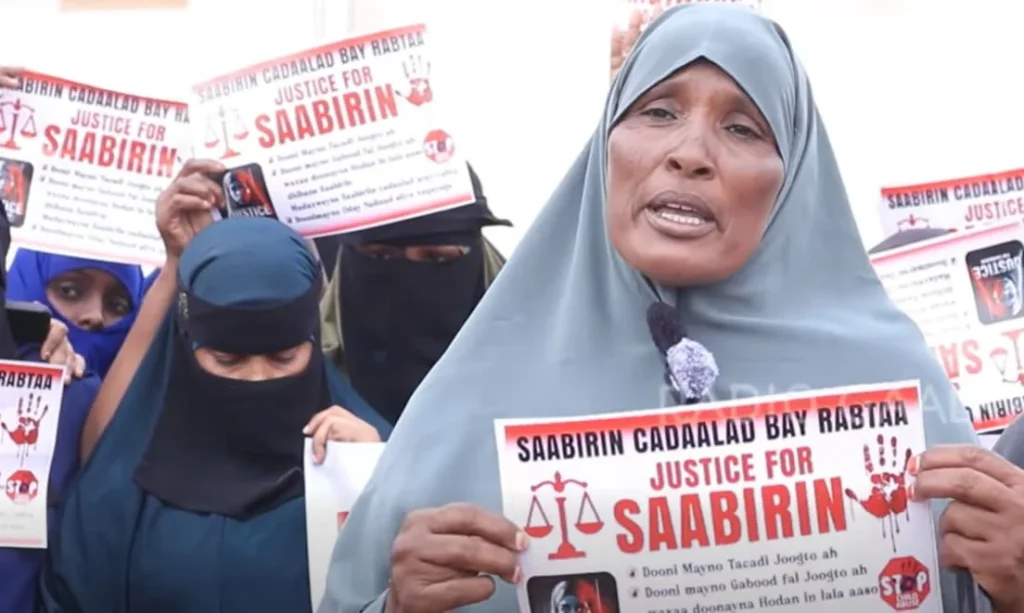
The leak of these details sparked immediate and justified outrage. Thousands of women and young people marched through the streets of Galkayo, one of Puntland’s largest urban centers. They carried signs reading “Justice for Saabirin” and demanded that the authorities prosecute not just the killer, but anyone who might have turned a blind eye to the girl’s suffering. This public pressure forced the semi-autonomous government to fast-track the trial and ensure total transparency.
The Ruling: Understanding Qisas and Islamic Law
In Puntland, and specifically within the Mudug region, the legal framework often utilizes “Qisas”. This is an Islamic legal principle centered on retaliatory justice. It is designed to provide closure to the victim’s family while maintaining social order.
Under the principle of Qisas, the family of a murder victim is presented with three distinct choices to resolve the case:
- Execution: The state carries out a death sentence against the perpetrator.
- Diyya (Blood Money): The victim’s family accepts a financial settlement as compensation, and the perpetrator’s life is spared.
- Pardon: The family chooses to forgive the killer unconditionally, often for religious or humanitarian reasons.
In the case of Saabirin Saylaan, the family was resolute. They refused all offers of financial settlement, despite the significant sums often involved in such negotiations. They demanded the full weight of the law. This led to the rare execution of a female convict by firing squad.
Governor Faysal Sheikh Ali of the Mudug region confirmed that the execution was conducted according to strict legal protocols. He noted that members of both Saabirin’s family and Diiriye’s family were present to witness the sentence. This presence is a traditional requirement intended to bring a definitive end to any potential blood feuds or lingering hostilities between the two clans.
A Rare and Powerful Precedent
Executions of women are exceptionally rare in Somalia. The last recorded instance in Puntland occurred in 2013, when 13 members of an extremist group were executed, including one woman involved in a high-profile assassination.
By applying the death penalty in a civil murder case involving a domestic worker, Puntland’s authorities have sent an unmistakable message. The ruling suggests that the life of a child—regardless of their social standing, wealth, or orphan status—carries a value that the state is willing to defend with the highest level of punishment. For many activists, this was a necessary step to deter the casual violence often meted out to domestic servants in private homes.
The Aftermath: A Call for Systemic Reform
While the firing squad provided “justice” in the legal sense, community leaders argue that an execution alone will not solve the structural issues that led to Saabirin’s death. The case has highlighted the extreme risks faced by thousands of young girls working in unregulated domestic settings.
Proposed Reforms Following the Tragedy:
- Formalizing Domestic Work: Human rights advocates are calling for new legislation that strictly prohibits the employment of minors. There are also calls for a registry of domestic workers to ensure they are tracked by the state.
- Mandatory Reporting Laws: There is a growing movement to hold community elders and extended family members legally accountable if they fail to report suspected child abuse.
- State-Led Orphan Protection: The tragedy has sparked a debate on the need for formal foster care. Activists argue that the current informal “kinship” system lacks the oversight necessary to prevent children from being sold or forced into labor.
As the dust settles in Galkayo, Saabirin Saylaan’s name remains a rallying cry. While her life was cut short by unimaginable cruelty, her legacy may well be the protection of the next generation of Somali children.
The case of Saabirin Saylaan has forced a difficult but necessary conversation about the safety of children in our homes. Do you believe that the rare application of ‘Qisas’ in this case will serve as a deterrent to future abuse, or is the solution found in deeper systemic reform? Share your thoughts in the comments below