
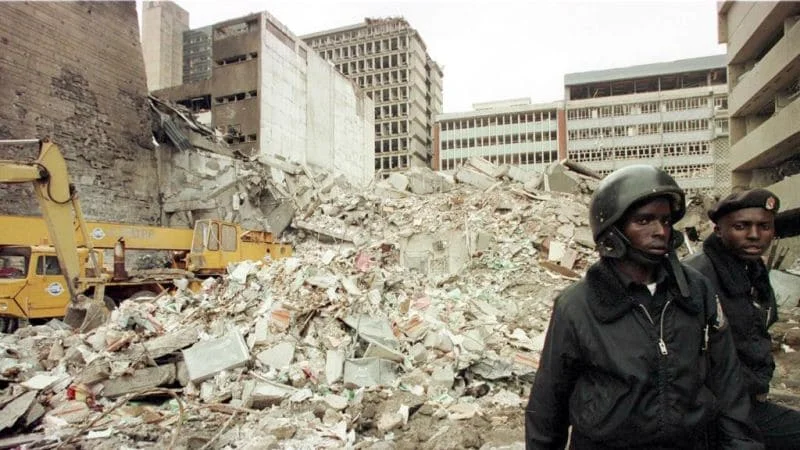
In a significant legal setback for survivors and grieving families, a Kenyan court on Wednesday dismissed a compensation petition related to the August 1998 bombing of the United States embassy in Nairobi.
The court ruled that there was insufficient evidence to prove that the Kenyan government acted negligently or ignored actionable intelligence prior to the terrorist attack.
The Ruling: A Question of Evidence
Judge Lawrence Mugambi presided over the case, centering his decision on the lack of “primary facts” provided by the petitioners. While the court acknowledged that the state has a constitutional duty to protect the right to life, it emphasized that liability requires clear proof of a specific failure.
Key reasons for the dismissal included:
- Intelligence Gaps: The court found the petitioners failed to demonstrate that specific intelligence existed which the government subsequently ignored.
- Security & Border Claims: Allegations regarding known immigration failures that supposedly allowed dangerous elements to enter the country were deemed unsupported by sufficient proof.
- Balance of Probability: Under Kenyan law, the burden was on the victims to prove that the government’s inaction directly led to the tragedy.
A Legacy of Devastation
The 1998 attack remains one of the deadliest events in East African history. A nearly simultaneous blast occurred at the US Embassy in Dar es Salaam, Tanzania, creating a regional crisis.
- Casualties: Over 200 people lost their lives, including 12 American citizens.
- Injuries: Thousands were wounded, the vast majority of whom were Kenyan locals.
- Financial Disparity: While the US government has already provided more than $5 billion in compensation to its own nationals and their relatives, local Kenyan victims have yet to receive similar reparations.
The Victims’ Response: “Truly Disheartened”
The consortium of victims, represented by Mike Kitivo, expressed deep frustration with the ruling. For nearly thirty years, these survivors have sought financial and legal recognition for their suffering.
“For close to three decades, these men and women… have been waiting for justice to be served. We are very disappointed,” Kitivo stated following the judgment.
Next Steps: The Global Stage
The legal battle is far from over. The victims’ group has announced plans to escalate the case to higher authorities, including:
- The Court of Appeal: To challenge the current ruling within the Kenyan judicial system.
- The International Criminal Court (ICC): To seek broader international justice.
- Financial Targeting: The group aims to pursue compensation from international banks suspected of financing al-Qaeda’s terrorist infrastructure.
READ ALSO: President Tinubu Stumbles During Official State Visit to Türkiye