It has been exactly one year since the fall of Goma, the provincial capital in the eastern Democratic Republic of Congo. On January 26, 2025, the city was seized by the M23 armed group following a rapid offensive that saw the Congolese army withdraw.
Today, Goma’s one million residents live in a state of “constant oppression,” according to government officials. They navigate a reality defined by administrative collapse, economic isolation, and arbitrary justice.
The Initial Trauma
The takeover was anything but peaceful. Thousands lost their lives during the intense clashes that marked the city’s fall. Civilians were caught in a crossfire with literally “nowhere to go.”
“Suddenly I heard my wife cry out. She fell, hit by a stray bullet,” recalls Janvier Kamundu (a pseudonym), who was sheltering at home when the city fell.
While his wife survived thanks to neighbors braving the gunfire to reach a hospital, many others were not as fortunate. Medical facilities were quickly overwhelmed, and morgues became crowded with victims of the stray rounds and street battles.
“Rough Justice” and the Stadium Prisons
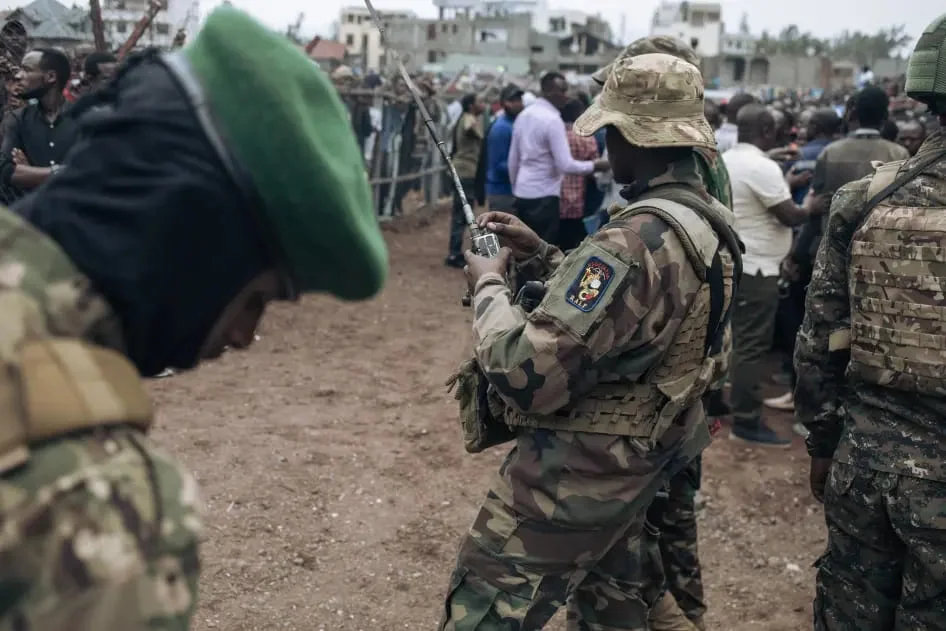
In the months following the capture, the M23 replaced the defunct national police and court systems with their own brand of security. The group began systematic neighborhood sweeps, cordoning off areas to search for “criminals.”
- Arbitrary Detention: Residents report being hauled off to the city’s sports stadium—now an open-air prison—for minor or superficial reasons, such as having an “untidy beard” or wearing “dirty clothes.”
- Identification Parades: Men are often forced to sit in the streets while local leaders are ordered to identify “upstanding citizens.” Those not cleared are detained.
- Secret Sites: While M23 spokesmen present these operations as a return to safety, non-governmental reports suggest a darker reality of torture and summary executions at hidden detention sites.
By October 2025, the M23 began appointing its own magistrates. However, observers note that these officials lack impartiality, often targeting political opponents or those accused of collaborating with pro-government militias.
Economic Paralysis
Goma’s economy has been systematically dismantled over the last twelve months. To prevent the rebellion from accessing funds, the Congolese government ordered the closure of all banks in the city.
The Financial Strain
- Currency Shift: With no access to Congolese banks or cash, the Rwandan currency has become the standard at local markets.
- Unemployment: Civil servants have been hit hardest. In some departments, only about 10% of the original staff remain active, having moved to government-held territory.
- Trade Breakdown: The airport remains inaccessible, and trade with the rest of the country has slowed to a crawl.
Families like that of Madeleine Mubuto are seeing their savings vanish. “We had set aside a small amount of money… but after a year almost all of it is used up,” she says. Her husband, like many others, remains unemployed as the city’s infrastructure stagnates.
Forced Recruitment and Ideological Shifts
The M23 has aggressively sought to bolster its ranks, claiming to have added 7,000 new members by late 2025. This expansion includes the forced recruitment of both civilians and former government soldiers. To solidify their control, the group has also implemented mandatory “ideological training” for those who remain in the city.
A Fragile Future
Despite international peace efforts involving the United States and Qatar, the conflict shows no signs of cooling. In December 2025, the M23 launched a new offensive targeting the strategic town of Uvira near the Burundi border.
Government spokesman Patrick Muyaya suggests these actions prove that peace processes are being ignored by the M23’s backers. For the people of Goma, there is no escape. As Kamundu puts it, “We adapt because we have nowhere to go.”
READ ALSO: Agricultural Biotech: Nigeria’s $50M Drive for Climate-Resilient Seeds