The World Health Organization (WHO) has launched a landmark conference in New Delhi.
The summit aims to bridge the gap between centuries-old healing practices and modern science.
Opening on Wednesday, the event focuses on how cutting-edge technologies can validate traditional medicines. Specifically, experts are looking at how Artificial Intelligence (AI) can scientifically scrutinize ancient treatments.
The UN health agency argues that these tools are essential. They help governments ensure that traditional remedies are safe, effective, and compatible with modern healthcare.
A Global Reality, Not a Relic
WHO Director-General Tedros Adhanom Ghebreyesus dismissed the idea that traditional remedies are obsolete. In a video message, he highlighted the increasing global reliance on these methods.
“Traditional medicine is not a thing of the past,” Tedros stated. “There is a growing demand for traditional medicine across countries, communities, and cultures.”
Indian Prime Minister Narendra Modi echoed this sentiment. As a long-time advocate of yoga, Modi stated that the summit would intensify efforts to harness the full potential of these treatments. Notably, Modi supported the 2022 establishment of the WHO Global Centre for Traditional Medicine in Gujarat.
Bridging the Gap with “Frontier Science”
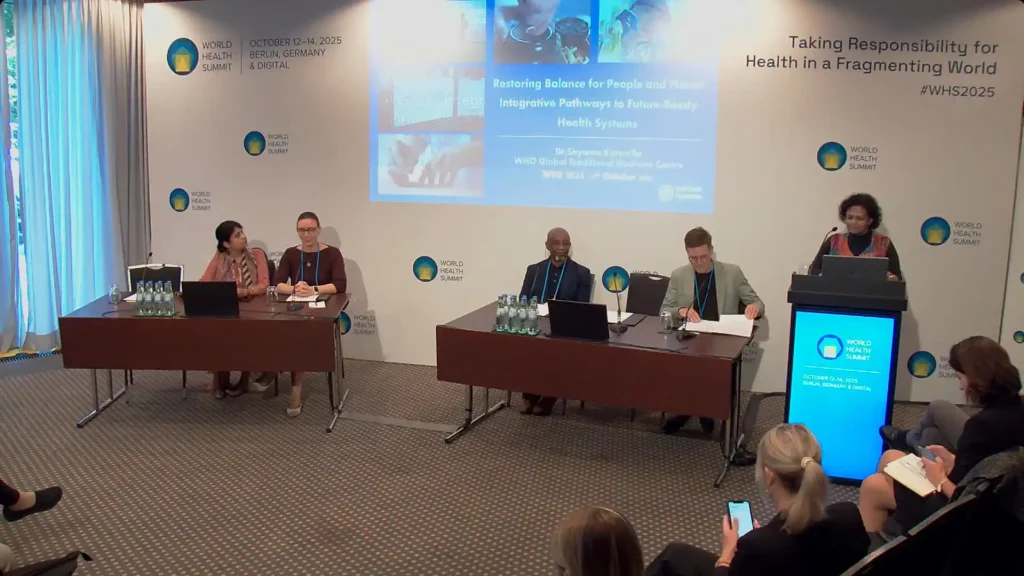
Shyama Kuruvilla, head of the WHO Global Centre, described traditional remedies as a “global reality.” She noted that between 40% and 90% of the population in nearly all WHO member states use these methods.
However, the challenge lies in distinguishing effective treatments from harmful ones. Conservationists also warn that demand for certain ingredients fuels the trafficking of endangered wildlife, such as rhinos and pangolins. To fix this, the WHO wants to ensure all medicine is “safe, evidence-informed, and equitably integrated.”
The Role of AI and Digital Repositories
The summit highlights a “transformative moment” where technology meets tradition. Dr. Sylvie Briand, WHO’s Chief Scientist, explained that AI is opening new doors for medical analysis.
- Brain Imaging: Advanced scans are showing how acupuncture and meditation affect the human body.
- Evidence Base: The WHO is launching the world’s largest digital library on the subject, containing 1.6 million scientific records.
From Nature to the Pharmacy
The connection between natural remedies and modern drugs is already strong. In fact, roughly 40% of Western pharmaceuticals are derived from natural products.
Examples of Nature-Based Medicine:
- Aspirin: Developed from willow tree bark formulations.
- Contraceptive Pills: Created using the roots of the yam plant.
- Cancer Treatments: Based on Madagascar’s rosy periwinkle flower.
- Malaria Treatment: Artemisinin was developed using ancient Chinese medical texts.
“It is the frontier science that’s allowing us to make this bridge,” Kuruvilla concluded. “We are finally connecting the past and the future.”