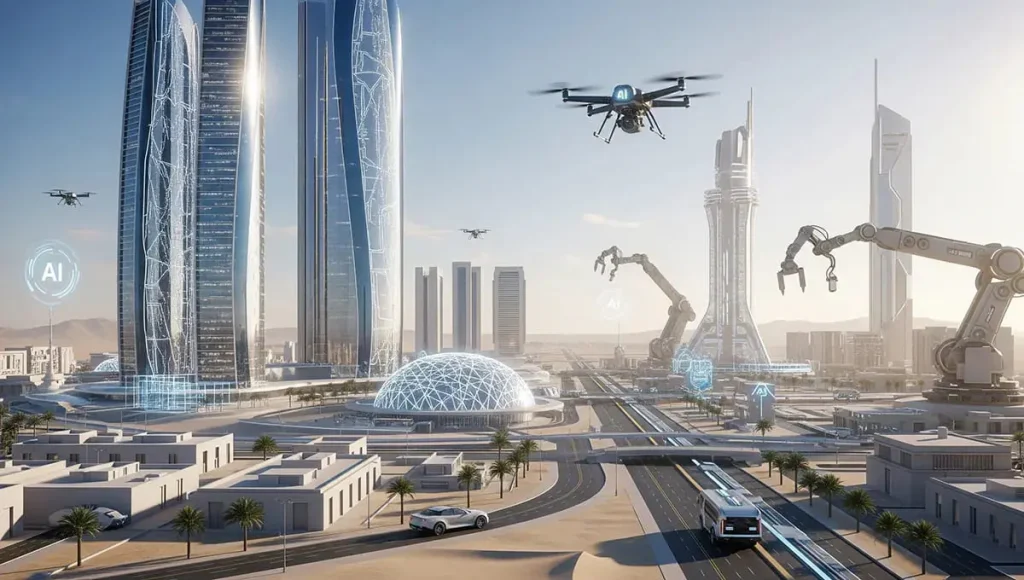
In the sprawling sands of Abu Dhabi, a transformation is underway that rivals the discovery of oil in the 1960s.
Towering construction cranes are currently assembling a colossal artificial intelligence campus. The site is immense covering an area roughly one-quarter the size of Paris and represents the United Arab Emirates’ aggressive bid to future-proof its economy.
For decades, crude oil was the engine that turned nomadic desert outposts into a global diplomatic heavyweight. Now, facing a future where global oil demand will eventually decline, the Emirates are pivoting. The goal is to become an “AI-native nation,” trading black gold for data.
The ‘Stargate’ of the Middle East
The crown jewel of this initiative is a new data center cluster known as Stargate UAE.
Spearheaded by G42, the Emirati tech giant chaired by the President’s brother, Sheikh Tahnoon bin Zayed Al Nahyan, the project is staggering in scale. Once complete, the facility will demand five gigawatts of electricity, making it the largest data center complex outside the United States.
Johan Nilerud, Chief Strategy Officer at G42 subsidiary Khazna Data Centres, noted that the infrastructure is designed to serve a storage and computing radius of 3,200 kilometers. This reach covers approximately four billion people.
International heavyweights are already buying in. Phase one will be operated by OpenAI, with backing from Silicon Valley titans including Oracle, Cisco, and Nvidia. Furthermore, Microsoft recently committed over $15.2 billion in investments to the region by 2029.
Quest for AI Sovereignty
The UAE is not content to merely host foreign tech; it wants to own the intellectual property.
Eric Xing, president of the Mohamed bin Zayed University of Artificial Intelligence (MBZUAI), emphasized that relying solely on imported technology is risky. He argued that “sovereignty and self-sustainability” are critical for the nation’s long-term success.
To achieve this, the government has poured billions into domestic research.
- Education: In 2019, Abu Dhabi launched MBZUAI, the world’s first university dedicated entirely to artificial intelligence.
- Curriculum: As of last August, AI is now a core subject in public schools, starting from kindergarten.
- Development: The Technology Innovation Institute (TII) has released “Falcon,” a generative AI model that rivals top global competitors and includes a dedicated Arabic version.
Energy, Money, and Geopolitics
While the US and China lead the global AI race, the UAE holds two distinct advantages: deep pockets and abundant energy.
Data centers are voracious consumers of electricity. With vast reserves of oil, gas, and year-round solar potential, the UAE can build power stations faster than most rivals.
However, the path is not without diplomatic hurdles. The UAE must navigate the tense tech war between Washington and Beijing to secure essential hardware.
This delicate balancing act recently paid off. Following intense lobbying, the US government authorized the export of advanced Nvidia chips to the UAE, a critical win for their infrastructure ambitions.
Despite the progress, experts warn that the sector remains volatile. Professor Jean-Francois Gagne of the University of Montreal noted that while the UAE is betting big, the industry is still evolving.
“Everyone is betting on different players,” Gagne observed, “but some will lose, and some will win.”
What do you think? Can artificial intelligence truly replace oil as the backbone of a national economy, or is this a gamble too big to win? Share your thoughts in the comments below.
READ ALSO: Smuggling Balloons Ground Flights as Lithuania Declares Emergency Over ‘Hybrid Attack