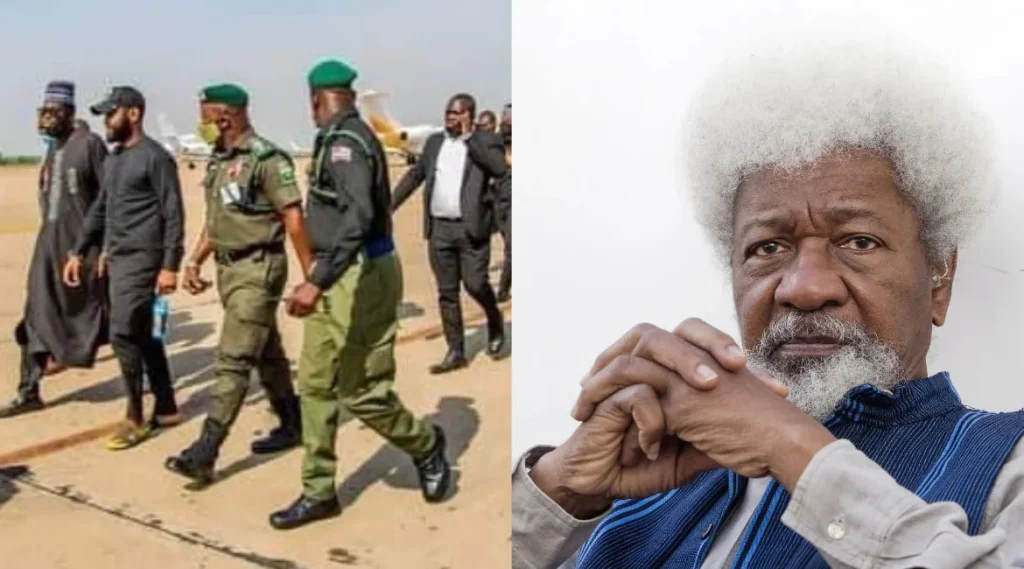
Nobel Laureate Wole Soyinka has issued a stinging rebuke regarding the optics of power in the current administration, specifically questioning the military-grade security detail assigned to the President’s family.
Speaking at the 20th Wole Soyinka Centre for Investigative Journalism Awards, the literary giant recounted a recent, jarring encounter that highlighted what he views as a misplacement of national priorities.
The Ikoyi Incident
The critique stemmed from a personal observation at a hotel in Ikoyi, Lagos. Soyinka described witnessing a security mobilization so massive and aggressive that he initially believed the nation was hosting a foreign Head of State or facing a critical emergency.
However, the “excessively large security battalion” which Soyinka noted was sufficient to seize control of a small nation—was not protecting a visiting president. It was deployed for Seyi Tinubu, the President’s son.
The discovery left the Professor stunned. He immediately sought to contact National Security Adviser Nuhu Ribadu, who was in Paris on official duty at the time, to demand an explanation.
Inheriting State Power
Soyinka’s conversation with the security chief was blunt. He questioned whether the architecture of state security had been redefined to treat the “child of the head of state” as a sovereign authority.
“Children must understand their place,” Soyinka asserted. He argued that biological proximity to the Presidency does not confer constitutional authority. According to him, the family members of elected officials must not “inherit the architecture of state power.”
Misallocation of Resources
The criticism goes beyond optics. At a time when Nigeria is battling widespread kidnapping, rural banditry, and insurgency, Soyinka highlighted the bitter irony of concentrating a heavy armed unit around a single private citizen.
He noted, with a touch of dark humor, that if the President’s son requires an entourage of that magnitude, perhaps the government should deploy him to the frontlines to handle the nation’s insurgency personally.
Beyond the humor, Soyinka emphasized that security deployments must reflect national realities and fairness, not privilege.
Regional Risks and Urban Dignity
The Nobel Laureate also used the platform to address broader governance issues, warning the federal government against military adventurism.
Referring to the recent instability in the neighboring Benin Republic, Soyinka cautioned against “unnecessary military entanglement.” He argued that Nigeria’s focus should remain on reinforcing democratic institutions at home rather than reacting reflexively to regional coups, warning that instability next door inevitably spills over.
Closer to home, he criticized the execution of ongoing demolitions in Lagos. While acknowledging the need for urban reforms, he revealed he had received distressing images of displaced families. He urged authorities to ensure that the drive for development does not strip citizens of their humanity or dignity.
READ ALSO: One Battle After Another Dominates 2026 Golden Globe Nominations with 9 Nods