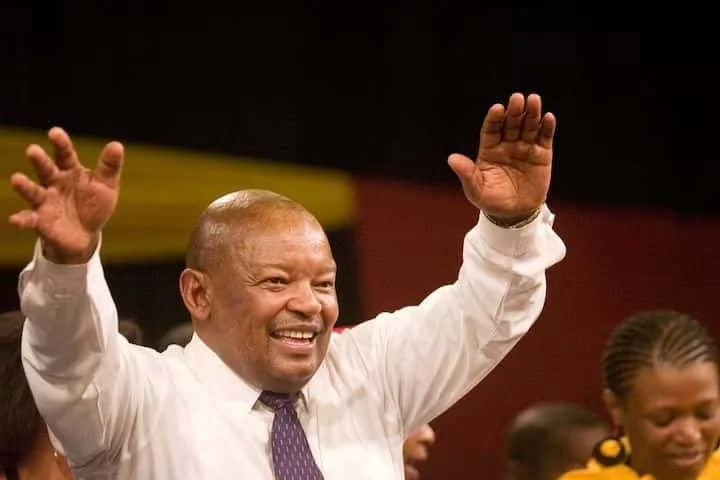
South Africa has lost one of its most courageous and complex political titans. Mosiuoa “Terror” Lekota, the former Defense Minister and anti-apartheid veteran, passed away on Wednesday, March 4, 2026, at the age of 77. His political party confirmed the news, noting that the leader succumbed to a long illness. This marks the end of a career defined by an unbreakable spirit and a commitment to justice.
Lekota was not just a politician. Instead, he was a living bridge between the dark days of apartheid and the vibrant reality of modern South African democracy.
His nickname, “Terror,” was originally earned on the soccer field. However, it later became a perfect fit for his fierce style of political debating. Throughout his life, he remained a man who was never afraid to stand alone for his principles.
From Robben Island to the Union Buildings
Lekota’s journey began in the heat of resistance. As a young activist in the 1970s, he emerged as a prominent leader within various youth organizations. He fought tirelessly against the systemic oppression of white minority rule. Unfortunately, his defiance came at a heavy price. The state sentenced him to eight years on the infamous Robben Island.
From 1974 to 1982, Lekota lived in the shadow of the world’s most famous political prisoners. He was jailed alongside giants like Nelson Mandela, Walter Sisulu, and Govan Mbeki. These years in the “university of the struggle” shaped his entire worldview. Most importantly, they instilled in him a deep commitment to non-racialism and constitutional integrity.
Even after his release, the apartheid state could not silence his voice. Authorities jailed him again for his continued grassroots activism. This proved that no amount of steel bars could dampen his resolve or his love for his country.
The Minister Who Built a New Army
When the dawn of democracy finally arrived in 1994, Lekota transitioned seamlessly from a revolutionary to a statesman. He served with distinction as the National Chairperson of the African National Congress (ANC). This was the movement to which he had dedicated his entire adult life.
In 1999, he was appointed as the Minister of Defense. He held this high-ranking post for nearly a decade. Consequently, he faced one of the most difficult jobs in the new government. Lekota was tasked with merging former apartheid soldiers and guerrilla freedom fighters into a single, unified national defense force.
His success in this role provided the stability that the young “Rainbow Nation” desperately needed. He managed to foster a sense of shared purpose among men who were once bitter enemies on the battlefield.
The Great Political Divorce: The Birth of COPE
Lekota’s most controversial and historic moment occurred in 2008. After former President Thabo Mbeki was ousted from the ANC leadership by Jacob Zuma, Lekota felt the party had lost its moral compass. He believed the movement was drifting away from the core values of the Freedom Charter.
In a move that stunned the nation, he handed in his “divorce papers” to the ANC. He broke away to form the Congress of the People (COPE). This was the first major fracture in the ANC’s absolute dominance since the end of apartheid. It was a bold gamble that permanently altered the political landscape of South Africa.
The 2009 Political Shockwave
Lekota’s new party initially looked like a powerhouse. In the 2009 elections, COPE achieved results that many thought were impossible for a brand-new organization:
- 3rd Largest Party: It immediately became a major force in the National Assembly.
- National Vote Share: It secured 7.42% of the vote, representing 1,311,027 citizens.
- Parliamentary Seats: It won 30 seats, bringing a fresh, critical voice to the 400-member parliament.
The Final Chapter: Principles Over Seats
The later years of Lekota’s career were undoubtedly more difficult. Internal squabbles and legal battles within COPE led to a slow decline in the party’s popularity. By the 2024 general elections, the party’s fortunes had shifted dramatically.
In that watershed year, the ANC finally lost its outright majority for the first time. However, COPE failed to win any seats at all. This effectively ended Lekota’s long career as a lawmaker. Despite this setback, his influence as a senior statesman remained significant.
In 2025, he officially stepped back from active leadership due to his declining health. He left the party in the hands of an acting leader, spending his final months away from the public eye.
Tributes from a Grateful Nation
The news of his passing has drawn tributes from across the entire political spectrum. This proves that even those he criticized deeply respected his history and sacrifice. Bantu Holomisa, the leader of the UDM and Deputy Minister of Defense, captured the sentiment shared by many South Africans.
“He decided to leave the ANC and formed COPE… by doing so, he literally strengthened the opposition parties. His role was not doubted because he understood the passage of the struggle. He knew the original agenda.”
Holomisa’s words remind us that Lekota’s decision to leave his political home was born out of a desire for a healthier democracy. He believed that no single party should be bigger than the constitution.
A Final Farewell to a Patriot
Mosiuoa “Terror” Lekota was a man of principles who valued the law above party loyalty. Whether he was defying the apartheid police or challenging the leadership of the ANC, he did so with a sharp mind. He possessed a fearless heart that never wavered, even when the odds were stacked against him.
South Africa has lost a giant who believed that democracy is only as strong as the voices willing to dissent. Today, the nation is more politically diverse and vibrant because he had the courage to say “no” when it mattered most.
Mosiuoa “Terror” Lekota: 1948 – 2026;
What is your most enduring memory of “Terror” Lekota? > Whether it was his time on Robben Island or his bold decision to form COPE, Mosiuoa Lekota’s legacy is one of the most debated in South African history. We want to hear from you. Share your thoughts or a tribute in the comments below.