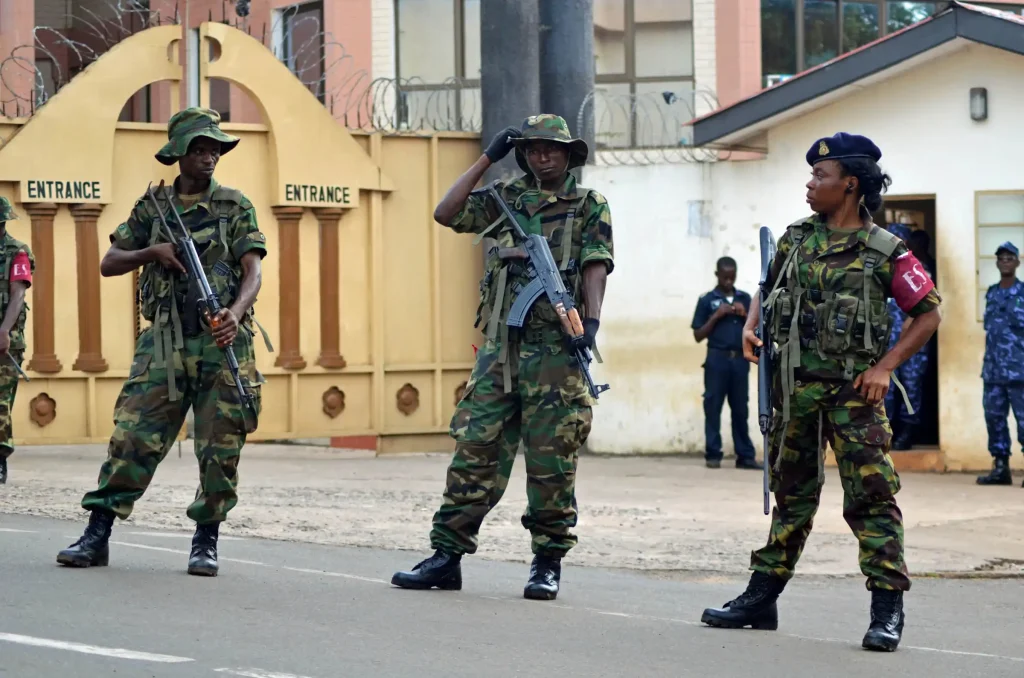
In a significant move toward regional stability, Guinea has officially released 16 security personnel from Sierra Leone who were detained earlier this week. The group, consisting of both soldiers and police officers, was handed over on Friday, March 6, 2026. This release follows a high-stakes border incident that threatened to strain the long-standing relations between these two West African neighbors.
The Ministry of Information in Freetown confirmed the development via an official social media announcement. They stated that all arrested officers have been “safely handed over” to the Sierra Leonean authorities. This peaceful resolution comes as a major relief to the international community, which had been monitoring the escalating tensions with growing concern.
Conflicting Narratives: The Incident at Kaliyereh
The tension began on Tuesday when Guinean forces apprehended the 16 men near the frontier town of Kaliyereh. As is common in complex territorial disputes, both nations provided vastly different accounts of the events leading up to the arrests.
The Perspective from Freetown
According to the government of Sierra Leone, the security team was engaged in legitimate state infrastructure development. Officials explained that the men were overseeing the construction of a new border post and an additional administrative facility. Freetown maintains that the team was operating entirely within its own sovereign territory when Guinean armed forces arrived and took them into custody.
The Perspective from Conakry
Conversely, authorities in Guinea (Conakry) characterized the situation as an unauthorized incursion. Guinean officials claimed that several dozen armed Sierra Leonean personnel had entered their territory without the necessary permits or notification. They argued that their security forces acted decisively to protect their national borders by apprehending those they viewed as trespassers.
A Diplomatic Path to De-escalation
Despite the initial military friction and the potential for armed conflict, the political leadership in Conakry signaled early on that they preferred a peaceful solution. Prime Minister Amadou Oury Bah promised on Thursday that the dispute would be settled quickly through diplomatic channels rather than further military confrontation.
The successful handover on Friday suggests that high-level talks between Freetown and Conakry were productive. By choosing a diplomatic exit, both countries have successfully avoided a more significant confrontation that could have destabilized the fragile border region. This resolution highlights the importance of open communication lines in managing spontaneous frontier disputes.
Historical Context: A Border Defined by Conflict
The current friction between Sierra Leone and Guinea is not an isolated event. It is deeply rooted in a complex shared history that dates back more than two decades. The two nations share a 700-kilometer border, much of which remains poorly demarcated or actively contested by local communities and national governments alike.
The origins of these territorial disagreements are largely tied to the Sierra Leone Civil War, a brutal decade-long conflict that ended in 2002. During that time, Guinea played a pivotal role in the region’s security. Guinean troops were deployed across the border to assist Freetown in fighting rebel groups. While this was initially a vital act of regional solidarity, it led to Guinean forces establishing long-term positions in areas that Sierra Leone now claims as its own.
The Long Shadow of the Yenga and Kaliyereh Disputes
The area where this latest incident occurred has been a flashpoint for over 20 years. While Freetown insists that these specific zones are rightfully Sierra Leonean territory, Guinea has maintained a continuous military presence on the ground since the end of the civil war era.
This “frozen” conflict periodically flares up whenever one side attempts to change the status quo. In this case, the construction of new infrastructure, like the border post at Kaliyereh, acted as the trigger. The inability of both nations to finalize a permanent, mutually agreed-upon border demarcation leaves local populations and security forces caught in a state of administrative confusion.
Regional Stability: The Role of ECOWAS and the Mano River Union
The stability of the Sierra Leone-Guinea border is essential for the wider West African region. Both nations are prominent members of several regional organizations designed to foster cooperation and peace:
- ECOWAS (Economic Community of West African States): As members of this influential bloc, both countries are committed to the principle of non-aggression and the peaceful settlement of disputes.
- The Mano River Union (MRU): Alongside Liberia and Ivory Coast, Sierra Leone and Guinea belong to this sub-regional body. The MRU was specifically created to promote economic integration and security cooperation among these four neighbors.
Because of these institutional ties, there is significant regional pressure to resolve border skirmishes quickly. A prolonged conflict would not only disrupt vital cross-border trade but also undermine the security frameworks that have kept the peace in the Mano River region for the last two decades.
Conclusion: Moving Toward a Permanent Demarcation
The release of the 16 officers on Friday is a clear victory for West African diplomacy. However, it also serves as a stark reminder that the underlying territorial issues remain unresolved. Until a formal and final border demarcation is legally ratified and physically marked, the risk of similar incidents at towns like Kaliyereh remains high.
For now, the safe return of the security personnel has de-escalated a potentially dangerous situation. The focus now shifts back to the diplomatic tables in Freetown and Conakry. Leaders from both nations must find a way to turn this temporary peace into a permanent agreement that respects the sovereignty of both states.
READ ALSO: The Mind-Reader in the Machine: How AI is Breaking the Final Frontier of Privacy