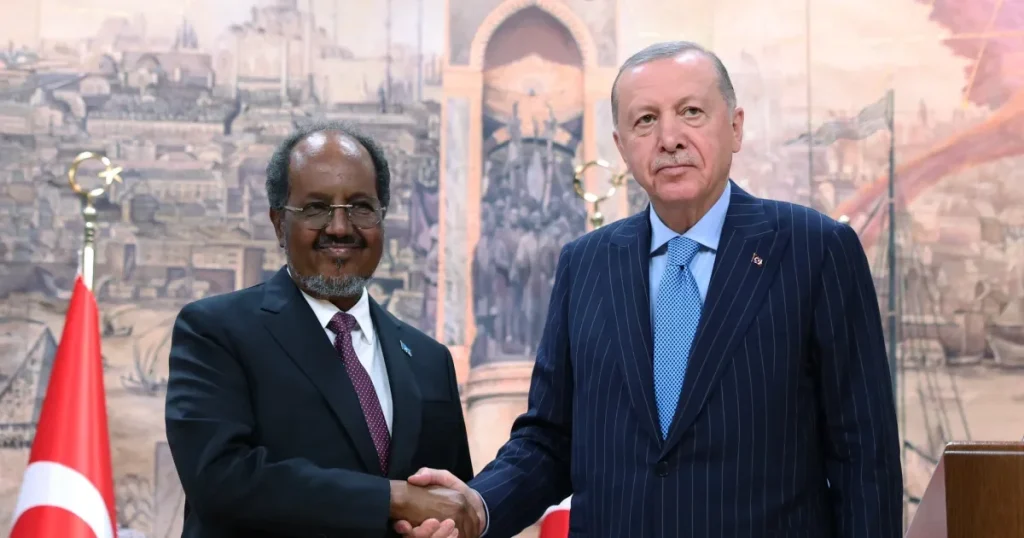
In a move that has sent shockwaves through the diplomatic corridors of the Red Sea, Turkish President Recep Tayyip Erdogan has issued a stinging critique of Israel’s decision to formally recognize the breakaway Republic of Somaliland.
Speaking during a high-stakes visit to Addis Ababa on Tuesday, February 17, 2026, Erdogan warned that the unilateral move by Jerusalem is a “blatant interference” that threatens to turn the Horn of Africa into a battleground for global powers.
The Turkish leader’s comments mark a significant escalation in the geopolitical rivalry between Ankara and Jerusalem, as both nations compete for influence over the strategic maritime chokepoints of the Gulf of Aden and the Bab-el-Mandeb Strait.
The Spark: Israel’s Historic Recognition
The current crisis traces back to December 26, 2025, when Israel became the first United Nations member state to officially recognize Somaliland as a sovereign nation. For Somaliland which declared independence from Somalia in 1991 but has existed in a state of diplomatic limbo for decades the announcement was a historic victory.
However, for the Federal Government of Somalia in Mogadishu, it was an “act of aggression.” Israel’s motivation is widely seen as a strategic play to secure maritime and intelligence advantages along the Red Sea. By establishing ties with Somaliland, Israel gains potential access to the port of Berbera, allowing it to counter Iranian-backed threats and monitor Turkish expansion in the region.
Erdogan’s “New Dynamic” and the Defense of Sovereignty
During his press conference alongside Ethiopian Prime Minister Abiy Ahmed, Erdogan was uncharacteristically blunt. He reiterated that Turkey values the territorial integrity of Somalia above all else and views any move to fragment the nation as “illegal and unacceptable.”
“We believe that the region’s problems should be resolved by the countries of the region themselves,” Erdogan stated. “The Horn of Africa should not be turned into an arena of struggle for foreign powers. Israel’s recognition of Somaliland benefits neither Somaliland nor the wider region.”
Ankara’s opposition is not merely rhetorical. Turkey has deep economic and military roots in Somalia, operating its largest overseas military base (Turksom) in Mogadishu and managing the capital’s primary airport and seaport. For Erdogan, Israel’s move is a direct challenge to a decade of Turkish soft-power investment.
The Diplomatic Domino Effect: Somalia vs. The UAE
The fallout from Israel’s decision has triggered a dramatic reconfiguration of alliances. In early January 2026, Somalia took the drastic step of severing all diplomatic ties with the United Arab Emirates (UAE). Mogadishu accused the UAE of facilitating the negotiations that led to Israel’s recognition, claiming that Abu Dhabi was actively undermining Somalia’s sovereignty.
The Timeline of Friction (Early 2026):
| Date | Event | Outcome |
| Dec 26, 2025 | Israel recognizes Somaliland | Somalia rejects the move as “null and void.” |
| Jan 12, 2026 | Somalia cancels all UAE agreements | UAE forces withdraw; ports and security deals annulled. |
| Jan 20, 2026 | Somalia signs pact with Qatar | Doha enters as a key security and financial partner. |
| Feb 4, 2026 | Turkey deploys F-16s | Ankara sends fighter jets to Mogadishu as a show of force. |
The UAE’s withdrawal has left a security vacuum in several regions, which Turkey and Qatar have been quick to fill. This shift has solidified a “Mogadishu-Ankara-Doha” axis, positioned directly against the “Hargeisa-Jerusalem-Abu Dhabi” alignment.
The Military Escalation: F-16s in Mogadishu
In a powerful display of military commitment, Turkey deployed three F-16 fighter jets to Mogadishu International Airport in early February 2026. This deployment, supported by newly constructed hangars and a permanent “Air Component Command,” serves two purposes:
- Counter-Terrorism: Supporting the Somali National Army (SNA) in its ongoing fight against al-Shabaab.
- Deterrence: Sending a clear signal to Somaliland and its new partner, Israel, that Turkey is prepared to defend Somalia’s airspace and territorial waters.
Somali Brigadier General Ibrahim Mohamed Mohamud, a graduate of Turkish military institutions, was recently appointed as the new commander of the SNA, further intertwining the military structures of the two nations.
Economic and Technological Stakes: Drilling and Spaceports
Beyond the military posturing, the struggle for the Horn of Africa is driven by massive economic projects slated for 2026. Turkey is scheduled to begin offshore energy drilling off the coast of Somalia later this year, using two newly commissioned drilling vessels.
Furthermore, Ankara has confirmed plans for a spaceport project in northern Mogadishu. The strategic location near the equator makes Somalia an ideal site for satellite launches, a capability that would significantly boost Turkey’s standing in the global space race. Israel’s presence in Somaliland is seen as a potential threat to these multi-billion dollar Turkish investments.
The Ethiopian Factor: A Quest for Sea Access
Adding a layer of complexity to the situation is Ethiopia. During Erdogan’s visit, Prime Minister Abiy Ahmed sought Turkish support for Ethiopia’s long-standing quest to secure permanent access to the sea.
Ethiopia had previously signed a Memorandum of Understanding with Somaliland for port access in exchange for recognition, a move that Turkey helped mediate through the “Ankara Declaration” of 2024. Now, as Israel enters the fray, Ethiopia is treading carefully, trying to balance its partnership with Turkey while ensuring it doesn’t lose its strategic maritime ambitions to the new Israel-Somaliland alliance.
Conclusion: A Precarious Balance in 2026
The Horn of Africa is currently at a crossroads. Israel’s recognition of Somaliland has shattered a long-standing African Union norm that borders should not be redrawn without continental consensus. By breaking this “diplomatic fiction,” Israel has forced the region into a reality of geopolitical competition.
President Erdogan’s forceful stance in Addis Ababa clarifies that Turkey will not stand by as its strategic interests are encircled. With F-16s now stationed in Mogadishu and offshore drilling rigs on the horizon, the stakes could not be higher. Whether this leads to a new era of regional integration or a prolonged “struggle of foreign powers” remains the defining question of 2026.
MORE NEWS: Dakar University Suspends Student Unions Following Fatal Campus Unrest