Today, Tuesday, February 17, 2026, the skies are hosting a celestial spectacle as the year’s first solar eclipse begins. While this event is scientifically significant, it is a remarkably exclusive experience.
Data shows that only two percent of the world’s population lives within the regions where the eclipse will be visible. For the rest of the planet, this astronomical phenomenon remains a distant, icy mystery unfolding at the edge of the world.
The “path of annularity” the specific track where the full effect can be seen—is currently sweeping across the remote reaches of Antarctica. This continent, primarily home to scientific research outposts and colonies of hardy wildlife, offers the only front-row seats for the peak of the event.
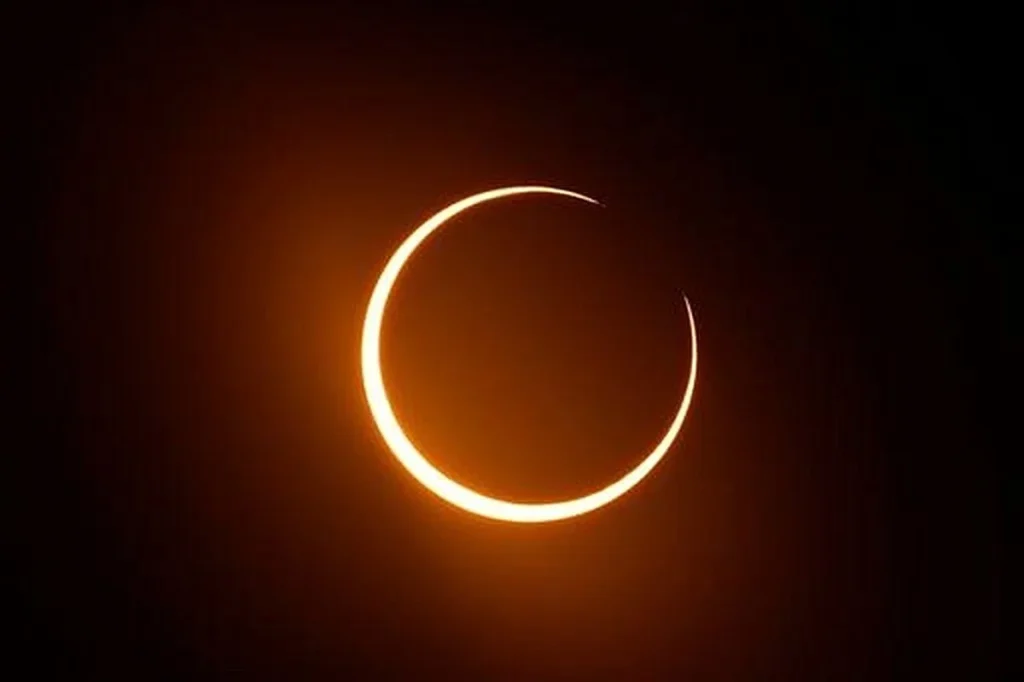
Understanding the “Ring of Fire”: Science of the Annulus
Not every solar eclipse results in total darkness. Today’s event is an annular solar eclipse, which occurs under specific orbital conditions. Unlike a total solar eclipse, where the moon completely obscures the sun, an annular eclipse happens when the moon is at its apogee—the farthest point from Earth in its elliptical orbit.
Because the moon is farther away, it appears slightly smaller in our sky than the sun. When it passes directly between our planet and the sun, it cannot cover the solar disk entirely.
Instead, it leaves a brilliant, glowing border of light visible around its dark silhouette. This striking effect is known as the “ring of fire,” derived from the Latin word annulus, meaning “ring.”
At the peak of today’s eclipse, approximately 96 percent of the sun’s center will be covered. However, that remaining four percent of light is incredibly intense, preventing the “day-into-night” transformation seen during total eclipses but creating an eerie, high-contrast dimming of the landscape.
Antarctica: An Audience of Researchers and Penguins
The shadow of the moon is currently racing across the Antarctic continent, making it the primary viewing zone. While major world cities remain in full daylight, the researchers at stations like Concordia (French-Italian) and Mirny (Russian) are witnessing a rare alignment.
For these scientists, the eclipse is more than a photo opportunity; it is a data-gathering mission. They are studying how the sudden, temporary loss of solar radiation affects the thin Antarctic atmosphere and the behavior of local wildlife.
Speaking of wildlife, the most numerous witnesses of today’s event are likely the Emperor and Adélie penguins. While we cannot know exactly how they perceive the “ring of fire,” past observations during eclipses suggest that animals often become quiet or exhibit “nighttime” behaviors as the light takes on a strange, silvery quality and the temperature drops suddenly across the ice shelf.
Partial Visibility: Africa and South America
While the full “ring” is reserved for the frozen south, a much larger region is experiencing a partial solar eclipse. Observers in parts of southern Africa and the southern tip of South America can see the moon take a “bite” out of the sun’s disk.
The South African Perspective
In South Africa, the eclipse is visible in the early afternoon. In cities like Cape Town and Gqeberha, the moon will obscure about five to fifteen percent of the sun. While this isn’t enough to significantly dim the day, it is a fascinating sight for those with the right equipment.
The South African National Space Agency (SANSA) has been active today, providing live updates and educational resources. They have used their specialized solar telescopes to livestream the event for millions who cannot see it in person, bridging the gap between the remote Antarctic path and the rest of the continent.
Critical Safety: Protecting Your Eyes
The most important rule for today’s event and any solar eclipse—is safety. Because the sun is never fully covered during an annular eclipse, looking at it with the naked eye is extremely dangerous.
Warning: Even a small sliver of the sun’s surface can cause permanent retinal damage, known as solar retinopathy. There are no pain receptors in the retina, so you may not even realize you are causing damage until it is too late.
How to Watch Safely:
- Certified Eclipse Glasses: Only use glasses that meet the ISO 12312-2 international safety standard.
- Specialized Filters: If using a camera, telescope, or binoculars, you must have a solar filter specifically designed for that device.
- Pinhole Projectors: A safe, low-tech way to view the eclipse is to project the sun’s image through a small hole onto a piece of paper.
Regular sunglasses, even polarized or very dark ones, provide zero protection for direct solar viewing.
The Rarity of the Path
Solar eclipses are not inherently rare they occur several times a year. However, the path of the shadow is usually narrow and often falls over open oceans or uninhabited land. The fact that today’s eclipse is centered so far south is a reminder of the precise, shifting geometry of our solar system.
Last year, the world saw two partial eclipses. Many still remember the massive total solar eclipse of 2024, which traversed North America and brought millions into the shadow. Today’s Antarctic event is the “quiet” opener for a year that will eventually bring more accessible celestial shows.
Looking Ahead: The Total Eclipse of August 2026
If you missed today’s “ring of fire,” you won’t have to wait long for the next major event. On August 12, 2026, a total solar eclipse will sweep across a much more populated path.
This upcoming event will be visible as a total eclipse from:
- Greenland and Iceland
- Spain and part of PortugalRussia
Vast areas of Europe, Africa, and North America will see a significant partial eclipse during the August event. Unlike today’s remote Antarctic shadow, the August eclipse is expected to be one of the most-watched astronomical events in history, as it passes over major European tourism hubs during the peak of summer.
Conclusion: A Cosmic Connection
Even if you are among the 98 percent of people who cannot see today’s eclipse, there is something profound about the event. As the moon’s shadow glides over the Antarctic ice, it serves as a reminder of our place in a clockwork universe. These alignments have fascinated humanity for millennia, evolving from omens of dread to celebrated moments of scientific wonder.
Whether viewed by a lone researcher in a polar lab or through a digital screen in a bustling city, the 2026 “ring of fire” is a beautiful testament to the silent, grand mechanics of the cosmos.
ALSO READ: Dunkirk Carnival: The Art of the Seagull Screeching Championship