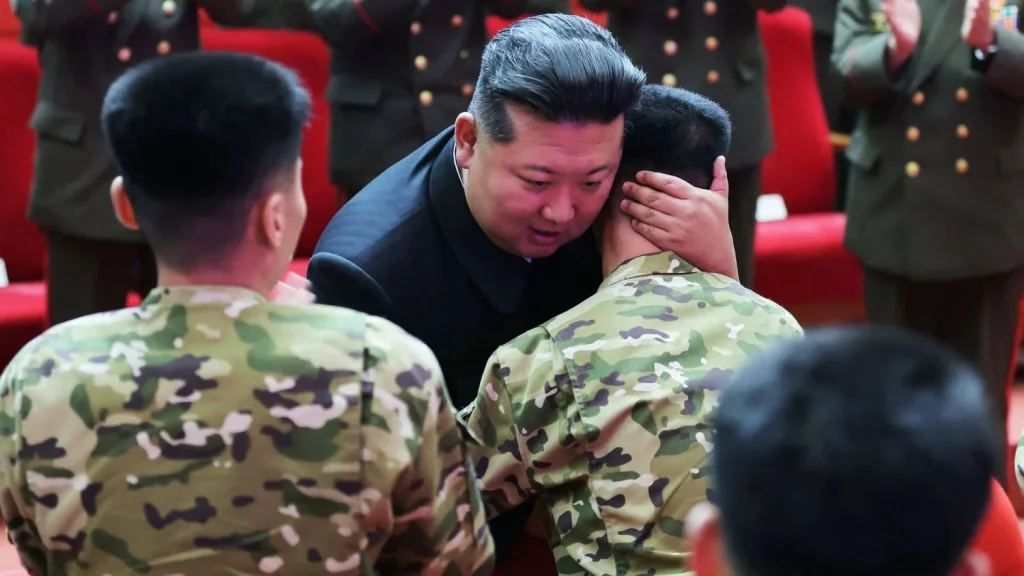
In a move that blends dynastic theater with high-stakes geopolitics, North Korean state media has released extensive footage of Supreme Leader Kim Jong Un touring the newly developed Saeppyol Street. Accompanying the leader was his daughter, a recurring figure in recent official outings, as they met with the relatives of soldiers termed “young martyrs.”
This public appearance serves as more than a routine inspection; it is a calculated performance of national grief and resilience.
While the images—saturated with carefully staged emotion—cannot be independently verified, they provide a window into the current psychological state of the Hermit Kingdom as it navigates a deepening and controversial alliance with Vladimir Putin.
The Theater of Saeppyol Street
The choice of Saeppyol Street for this visit is no accident. In the North Korean political lexicon, new infrastructure projects represent the “triumph of the socialist system.” However, the focus of this particular tour was not on the architecture, but on the people.
Kim’s interaction with the families of the fallen was notably intimate. State television showed the leader promising to honor the sacrifice of those he called “young martyrs.” This rhetoric signals a shift in the state’s internal narrative, moving from purely defensive postures to glorifying active participation in conflicts far beyond the nation’s borders.
The Symbolic Presence of the Daughter
The presence of Kim’s daughter remains one of the most scrutinized aspects of North Korean statecraft. Her participation in a tour centered on “martyrs” serves two primary purposes:
- Dynastic Continuity: It reinforces the idea that the “Paektu Bloodline” is directly connected to the sacrifices made by the youth.
- Humanizing the Leader: By appearing as a grieving father-figure alongside his own child, Kim Jong Un attempts to bridge the gap between the ruling elite and the families suffering the human cost of his military ambitions.
A Cult of Overseas Tributes
In recent months, Pyongyang has pivoted toward an aggressive campaign of public remembrance. This is not for the “Eternal President” or the “Great Leader” of the past, but for the contemporary soldier. The government has significantly increased its investment in:
- National Memorials: Large-scale monuments dedicated to “Internationalist Duty.”
- Museum Projects: New galleries showcasing the “heroism” of North Korean forces in foreign theaters.
- Media Tributes: Continuous broadcasting of documentary films honoring the “martyrs” of the modern era.
Analysts suggest this surge in memorialization is a preemptive strike against domestic unrest. By framing the deaths of soldiers as a sacred religious-like sacrifice, the state makes it socially and politically impossible for families to voice dissent or grief that isn’t filtered through the lens of patriotism.
The Moscow-Pyongyang Axis: A Deepening Alignment
The backdrop to this domestic propaganda is the escalating conflict in Ukraine. The alignment between Kim Jong Un and Vladimir Putin has transitioned from diplomatic pleasantries to a functional military partnership.
“Pyongyang is no longer a silent observer on the global stage. It has leveraged its military surplus and manpower to become a critical, albeit isolated, partner in Moscow’s war effort.”
This deepening bond provides North Korea with much-needed economic relief and potential technological transfers for its own missile programs. However, the price of this alliance is paid in North Korean lives. The “unity” Kim Jong Un is currently pushing at home is designed to mask the reality that his troops are now active participants in a war that many North Koreans likely do not fully understand.
The Human Cost: Quantifying the Sacrifice
While Pyongyang remains silent on the exact numbers, intelligence agencies in the South are painting a much grimmer picture of the situation on the front lines.
Casualty Estimates and Force Deployment
According to estimates from South Korea’s National Intelligence Service (NIS), the North Korean contingent has suffered significant losses.
| Metric | Estimated Figure |
| Total Troops Wounded | ~3,500 – 4,000 |
| Total Troops Killed | ~2,000 – 2,500 |
| Combined Casualties | ~6,000 |
These figures represent a devastating blow to the elite units reportedly sent to assist the Russian military. The loss of 6,000 personnel—whether through death or debilitating injury—creates a logistical and social vacuum that the state must desperately fill with the “martyr” narrative seen on Saeppyol Street.
ALSO READ: Hilda Baci Secures Third Guinness World Record: A New Milestone for the Celebrity Chef
Internal Unity as a Survival Strategy
Why the sudden “push” for unity? For the Kim regime, the biggest threat to its survival is not necessarily external intervention, but internal fracture.
If the news of thousands of casualties filters back to the general populace without a pre-packaged “heroic” context, it could spark a crisis of confidence. The museum projects and street tours are designed to ensure that when a family receives a “martyr’s certificate,” they feel a sense of state-mandated pride rather than a sense of betrayal.
Key Strategies for Domestic Control:
- Information Siloing: Ensuring only “glorious” accounts of the war reach the public.
- Social Rewards: Providing families of “martyrs” with better housing or food rations to incentivize silence.
- Collective Responsibility: Linking the success of the Russia-Ukraine partnership to the personal survival of every North Korean citizen.
The Verdict: A Fragile Narrative
Kim Jong Un’s tour of Saeppyol Street is a masterclass in autocratic damage control. By honoring “young martyrs” with his daughter by his side, he is attempting to transform a bloody foreign entanglement into a sacred national crusade.
However, as casualties continue to mount and the NIS data suggests a deepening human toll, the state’s ability to maintain this illusion will be tested. Propaganda can build museums, but it cannot indefinitely hide the absence of 6,000 young men from their homes and families.
As the war in Ukraine drags on, the world will be watching to see if Saeppyol Street remains a symbol of “modernity” or becomes a monument to a costly and avoidable tragedy.