
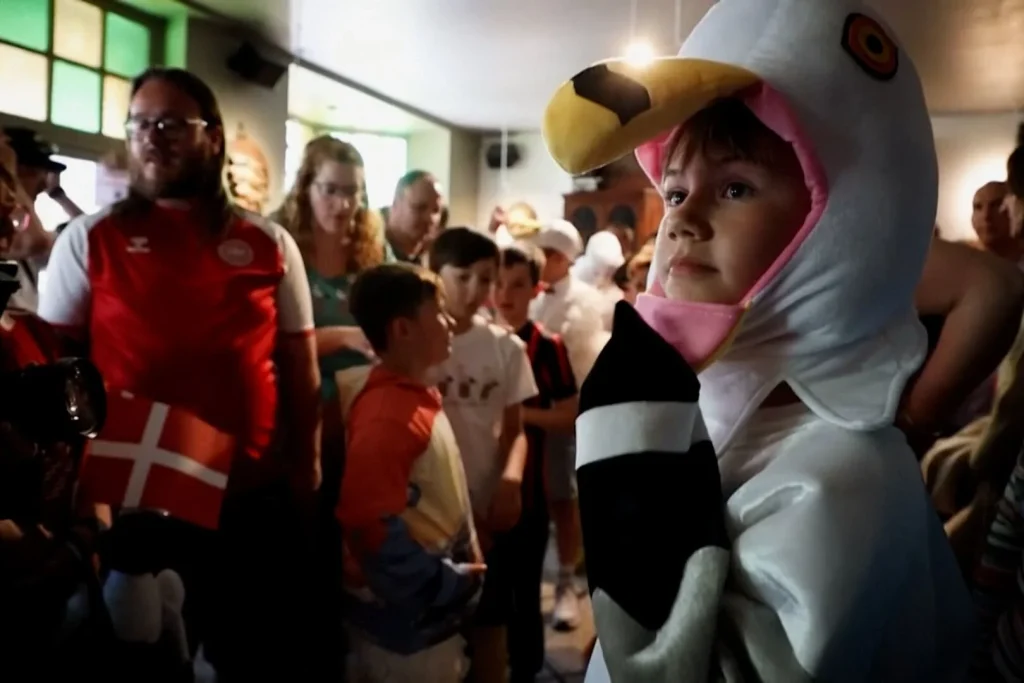
In northern France, the North Sea air carries the scent of salt and tradition. During the annual carnival season, a peculiar sound echoes through the streets. It is not the sound of drums or marching bands. Instead, it is the piercing, rhythmic cry of humans pretending to be seagulls.
Welcome to the European Seagull Screeching Championship, an event that has transformed from a quirky local pastime into a globally recognized cultural phenomenon.
Before hundreds of cheering spectators, contestants in elaborate, feathered costumes approach a banana-shaped microphone.
Their goal is simple yet daunting: deliver the most convincing, soul-shattering gull impression possible. This year’s festivities proved that the “art” of the screech is more popular—and more competitive—than ever before.
The Crowning of “Maître Mouette et Chandon”
The highlight of the 2026 competition was the crowning of a new champion who perfectly captured the spirit of the Dunkirk Carnival. The prestigious shield went to Laurie Duhaudt, known to the carnival faithful by her stage persona, “Maître Mouette et Chandon.”
Duhaudt’s performance was a masterclass in commitment. She stepped onto the stage in a costume featuring heart-shaped sunglasses, elegant pearls, and a meticulously crafted arrangement of white and gray gull plumage. She captured the audience’s attention before she even uttered a sound. When she finally leaned into the microphone, the resulting series of screeches were “hauntingly accurate” and “vibrantly energetic.”
Her victory was not just about volume. The jury—a panel of former champions and carnival veterans—evaluates contestants on specific criteria that separate the amateurs from the masters of the “mouette” (seagull).
The Judging Criteria: More Than Just Noise
To the uninitiated, the competition might seem like a chaotic shouting match. However, the regulars of the Dunkirk Carnival insist there is a profound level of precision involved. The championship is judged on three primary pillars:
1. Vocal Accuracy and Tone
A true Dunkirk seagull impression requires a deep understanding of the bird’s natural vocal range. Judges listen for the “rattle” at the beginning of the call, the sharp “peak” of the screech, and the rhythmic “laughter” that seagulls emit when scavenging. Timing is essential; a screech that is too short lacks impact, while one that is too long loses its avian authenticity.
2. Character Development
Success in the championship requires a distinct alter ego. Contestants do not simply walk on stage as themselves; they invent backstory-rich characters. Whether it is a “drunken sailor gull” or a “glamorous Parisian gull,” the persona must be consistent throughout the performance.
3. Costume and Physical Commitment
The visual aspect is as important as the vocal. The best contestants use their bodies to mimic a seagull’s movements—the frantic flapping of wings, the cocking of the head, and the aggressive “strut.” Costumes often involve repurposed feathers, yellow face paint for beaks, and inventive accessories.
Celebrity Cameos and Viral Momentum
The 2026 edition saw a significant boost in its digital profile, thanks to high-profile creators. Popular YouTuber Raphaël Carlier (of the comedy duo McFly and Carlito) tested his vocal cords on the Dunkirk stage. While Carlier braved the banana-mic, his creative partner David Coscas watched from the crowd, joining in the raucous laughter and applause.
This celebrity involvement underscores a shift in how traditional European festivals are viewed today. What was once a niche local tradition is now prime content for global audiences. The championship offers exactly what the internet craves: something noisy, visually striking, and completely original.
The Cultural Heart of the Dunkirk Carnival
The Seagull Screeching Championship sits within the broader Dunkirk Carnival, one of France’s most historic celebrations. Dating back centuries, the carnival originally served as a farewell party for fishermen departing for the dangerous waters off Iceland.
Today, the carnival is a weeks-long marathon of parades, “balls,” and communal singing. The seagull competition fits here because it mirrors the carnival’s core philosophy: “Le Chahut” (the hullabaloo). It is a time for social hierarchies to dissolve and for the “silly” to become high art.
By mimicking the seagull a bird often seen as a nuisance the people of Dunkirk turn a common frustration into communal joy. It is a form of satirical reclamation, celebrating the creatures that share their docks and steal their chips.
A Growing Global Phenomenon
As the championship concludes its most successful year, organizers are looking toward the future. Plans are underway to expand the “European” scope of the contest. They hope to encourage participants from other coastal nations like the UK, Belgium, and the Netherlands to bring their own regional gull impressions to the stage.
For those who have never witnessed the event, it is difficult to describe the energy. It is loud, it is absurd, and it is undeniably human. In a world that often takes itself too seriously, the Seagull Screeching Championship is a vital reminder of the power of collective laughter.
Conclusion: Why We Screech
The Dunkirk Seagull Screeching Championship proves that tradition doesn’t have to be solemn to be significant. Whether you are a local fisherman, a famous YouTuber, or a tourist, the screech is a universal language. It represents the freedom to be ridiculous and the pride of coastal identity.
As Laurie Duhaudt—Maître Mouette et Chandon—reigns as the 2026 champion, the message to future contestants is clear: bring your best feathers, find your inner bird, and do not be afraid to make some noise.
ALSO READ: Exiled Imam Mahmoud Dicko Calls for Peace in Jihadist-Stricken Sahel