
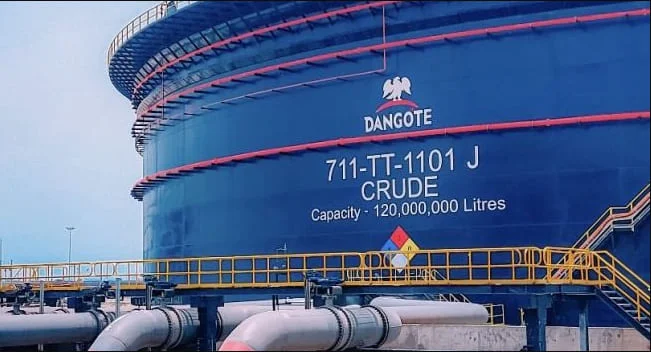
In a major move to recalibrate Nigeria’s energy market, the Dangote Petroleum Refinery has officially reduced the gantry price of its Premium Motor Spirit (PMS) by N25 per litre. Effective Tuesday, February 10, 2026, the ex-depot rate has dropped from N799 to N774 per litre, signaling a significant shift in the nation’s downstream pricing dynamics.
The price adjustment was communicated directly to petroleum marketers via the refinery’s Group Commercial Operations Department. Industry experts view this “price recalibration” as a strategic response to evolving market forces and improved operational scaling at the massive facility.
Official Pricing Update and Market Impact
The refinery’s internal notice confirmed the immediate implementation of the new rate. This revision has already been reflected across major industry pricing platforms, effectively providing a new benchmark for the domestic market.
“This is to notify you of a change in our PMS gantry price from N799 per litre to N774 per litre,” the refinery stated in its official communication to partners.
This reduction is expected to trickle down to retail pump prices, offering much-needed relief to Nigerian consumers and businesses alike. By lowering the entry cost for marketers, the refinery is positioning itself as the primary stabilizer in a previously volatile sector.
End of the PMS Lifting Incentive
Alongside the price reduction, Dangote Refinery announced the conclusion of its temporary lifting bonus program. The incentive window officially closed at midnight on February 10, 2026.
Key details regarding the bonus transition include:
- Final Deadline: The lifting bonus ended at 12:00 a.m. on February 10, 2026.
- Credit Posting: Volumes loaded between February 2 and February 10 will still qualify for credits, provided they met the pre-communicated volume thresholds.
- Long-term Strategy: Analysts suggest that by ending the volume-driven bonus while simultaneously lowering the base price, the refinery is moving toward a more stable, sustainable pricing regime.
Market Context: Transitioning from Volatility to Stability
This N25 reduction follows a turbulent period for Nigerian fuel prices. Throughout 2025, the downstream sector faced intense pressure following the removal of petrol subsidies and the onset of full deregulation. Prices fluctuated sharply between N700 and over N800 per litre, largely dictated by global crude costs and foreign exchange volatility.
The current reduction to N774 per litre marks a notable drop from the N799 rate seen at the start of the year. This shift suggests several positive developments within the Nigerian energy sector:
- Operational Efficiency: The 650,000 barrels-per-day facility is likely achieving better economies of scale as production ramps up.
- Reduced Import Reliance: Large-scale domestic supply is successfully moderating the “import parity” pricing that previously spiked costs.
- Increased Competition: The emergence of alternative supply channels and modular refineries is creating a more competitive environment for consumers.
The Strategic Importance of the Dangote Refinery
The Dangote Petroleum Refinery remains the cornerstone of Nigeria’s quest for energy independence. As Africa’s largest single-train refinery, its ability to shape downstream pricing often acts as the primary reference point for ex-depot rates across the continent.
By consistently providing a reliable domestic alternative to imported fuel, the refinery is not only stabilizing prices but also helping to conserve vital foreign exchange reserves. This latest price cut reinforces the facility’s role in driving Nigeria’s economic resilience in 2026.
READ ALSO: Guinea-Bissau: Opposition Leader Pereira Summoned Over Alleged Coup Ties