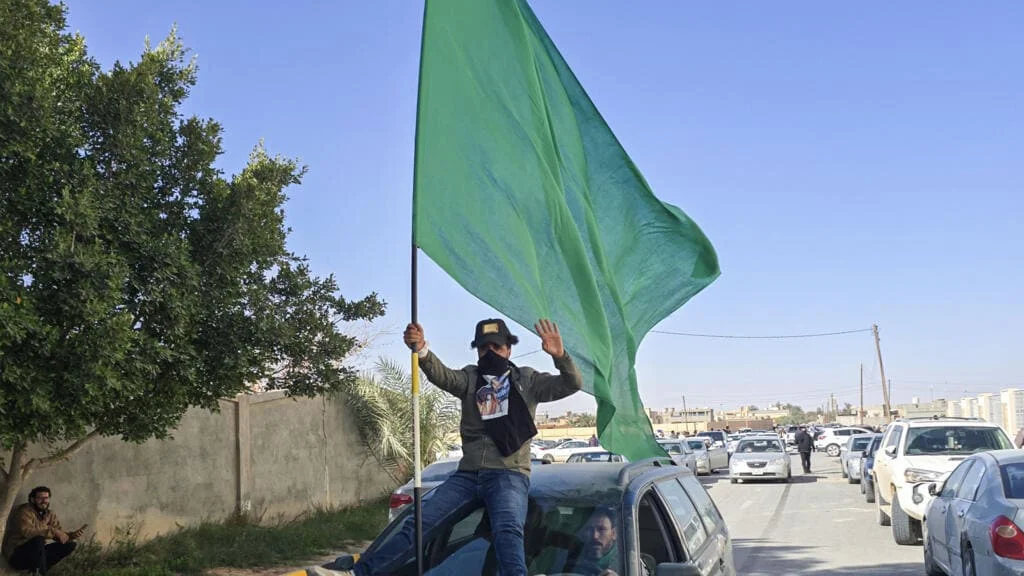
A massive gathering of mourners descended on the town of Bani Walid on Friday, February 6, 2026. They came to attend the funeral of Saif al-Islam Gaddafi, the son of the late Libyan leader Muammar Gaddafi. His death occurred on Tuesday following a targeted assassination that has sent immediate shockwaves through the nation’s fragile political landscape.
Saif al-Islam was once considered the likely successor to his father’s rule during the “Jamahiriya” era. He was fatally shot by unidentified gunmen at his residence in the northwestern city of Zintan. His death marks a violent and final end to the political aspirations of a man who had recently sought to return his family to power through the ballot box.
Bani Walid: A Stronghold in Deep Mourning
The choice of Bani Walid for the service was deeply symbolic. As a primary hub for the powerful Warfalla tribe, the town alongside the coastal city of Sirte remained a fierce bastion of support for the Gaddafi family even during the final days of the 2011 uprising.
The large turnout on Friday was heavily secured by local militias and tribal guards. This mobilization highlighted the enduring loyalty that large segments of the population still feel toward the former era. Despite the decade of chaos that followed the Arab Spring, many Libyans continue to view the Gaddafi period as a time of lost stability.
Mourners Travel Across Divided Borders
Mourners traveled from across the country’s fractured territories to pay their respects. The crowd was a mix of tribal elders, young “Green” movement activists, and families displaced by the ongoing civil strife.
“We have come to say goodbye to the one in whom we placed our hopes for the future,” said Waad Ibrahim. She is a loyalist who traveled nearly 300 kilometers from Sirte to attend the burial. Like many in attendance, she expressed deep suspicion regarding the motives behind the killing. She suggested that rival political factions viewed Saif al-Islam as an insurmountable hurdle to their own ambitions for total control.
Political Fallout and Official Responses
The assassination has further polarized a country already split between two competing administrations. Currently, the nation is divided between the UN-backed Government of National Unity (GNU) in Tripoli and the Government of National Stability (GNS) in the east.
Absences and Official Reactions
The funeral was notable for its lack of official representation, revealing the deep-seated animosity that remains:
- Government Silence: No high-ranking officials from either the Tripoli or Benghazi administrations attended the funeral.
- GNU Condemnation: Prime Minister Abdelhamid Dbeibah issued a formal statement condemning the act. He noted that “assassinations never provide stability… but rather deepen division.” He advocated for a state governed by the rule of law rather than “the law of the gun.”
- Public Speculation: In the streets of Tripoli, the atmosphere was a mix of relief and fear. Some residents suggested the killing was a calculated move to clear the field for the long-delayed presidential elections.
“They succeeded in excluding him from the political scene by assassinating him,” noted Tripoli resident Sabri Gachout. “He had a massive following that the current leaders simply could not compete with.”
The Anatomy of a Failed Political Comeback
Saif al-Islam’s death brings a definitive and tragic close to his attempt at a political comeback. After disappearing from public life following the 2011 rebellion during which he was captured and held in Zintan—he re-emerged in 2021. He officially announced his candidacy for president, surprising international observers and sparking hope among his supporters.
Constitutional and Legal Hurdles
His path to the presidency was never smooth. He faced a series of challenges that eventually led to a legislative stalemate:
- Legal Disqualification: The national elections committee initially disqualified him, citing his previous legal convictions.
- The ICC Conflict: He remained subject to an arrest warrant from the International Criminal Court (ICC) for crimes against humanity, a fact that complicated his international legitimacy.
- Indefinite Postponements: National polls intended to unify the country have been indefinitely delayed. These delays were caused by intense disputes over candidate eligibility and the lack of a permanent constitutional framework.
A Vacuum in the “Green” Movement
For his supporters, Saif al-Islam represented a link to a more predictable and prosperous past. For his detractors, he was a symbol of the authoritarianism they fought to overthrow in a bloody revolution. His assassination leaves a massive vacuum in the “Green” movement. This movement consists of those who remain loyal to the ideology of the former regime and who had pinned their hopes on a Gaddafi restoration.
His death also raises urgent questions about the safety of political figures in Libya. If a high-profile figure like Saif al-Islam can be assassinated in a supposedly secure residence, the prospects for a peaceful and democratic transition appear dimmer than ever.
Conclusion: An Uncertain Path Forward
As the 2026 political season continues, Libya remains a nation caught between its past and an uncertain future. The assassination in Zintan and the massive funeral in Bani Walid prove that the ghost of the 2011 revolution still haunts every corner of the country.
The immediate concern for the international community is whether this event will trigger a new wave of reprisal killings. For the mourners in Bani Walid, however, the focus is on the loss of a leader they believed could bridge the gap between Libya’s rival factions. Whether through the ballot or the bullet, the Gaddafi name continues to be the most divisive element in the quest for a unified Libyan state.
ALSO READ: Kenya Issues Warning: Cash Bouquets Could Lead to Seven Years in Prison