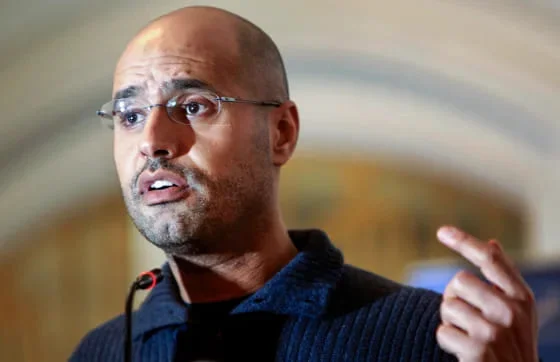
Libyan officials confirmed on Tuesday that Seif al-Islam Gadhafi, the son of the late former leader Moammar Gadhafi, has been killed.
He was reportedly killed in the mountain town of Zintan, which had been his primary residence for nearly a decade.
While government officials have yet to release a formal statement regarding the exact circumstances of his passing, local media reports suggest that armed assailants attacked him within his private residence.
The Rise and Fall of the “Reformist” Face
Born in June 1972, Seif al-Islam was once considered the most likely successor to his father’s four-decade rule. Educated in the West, he earned a PhD from the London School of Economics. This background earned him a reputation as a potential reformer who might bridge the gap between Libya and the international community.
However, that image shattered during the 2011 popular uprising. As NATO-backed forces moved against the regime, Seif al-Islam abandoned his diplomatic stance to defend his father’s government.
From Capture to Living in Zintan
The year 2011 was a turning point for the Gadhafi family. Moammar Gadhafi was toppled after more than 40 years in power and killed later that year during the civil war. Seif al-Islam attempted to flee the country, hoping to reach neighboring Niger, but was captured by fighters in the Sahara desert.
He was held in Zintan for several years. Although the group that captured him officially released him in June 2017, he remained in the town, occasionally making headlines with rumors of a political comeback.
Legal Battles and War Crimes
Seif al-Islam’s death brings an abrupt end to years of complex legal disputes. He was a wanted man on two major fronts:
- Domestic Conviction: In 2015, a court in Tripoli sentenced him to death in absentia. The charges included the incitement of violence and the murder of peaceful protesters during the 2011 revolution.
- International Charges: The International Criminal Court (ICC) also issued a warrant for his arrest. He was accused of crimes against humanity, specifically targeting civilians during the early stages of the Libyan uprising.
What This Means for Libya’s Future
The death of Seif al-Islam removes a controversial figure from Libya’s fractured political landscape. While some loyalists viewed him as a symbol of the old regime who could provide stability, others saw him as a reminder of a dark chapter in the nation’s history.
His passing leaves many questions unanswered regarding the reconciliation process in a country still struggling to find a unified path forward since the fall of the Gadhafi dynasty.
Quick Facts: Seif al-Islam Gadhafi
Born: June 1972
Education: PhD, London School of Economics
Role: Son and former heir apparent to Moammar Gadhafi
Capture Date: November 2011
Location of Death: Zintan, Libya