

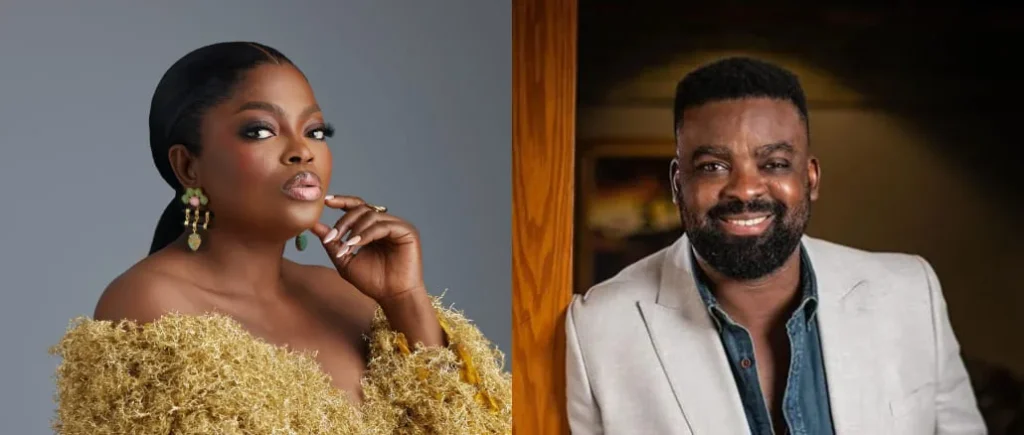
For decades, the name Kunle Afolayan has been synonymous with cinematic prestige. Meanwhile, Funke Akindele has become the undisputed queen of the Nigerian box office. Recently, however, a quiet tension simmered beneath the surface of the industry. This tension finally boiled over into a public, high-stakes debate. This is not just a personal spat. Instead, it is a fundamental clash over the future of Nollywood’s identity.
The rift between the “Cinematic Purist” and the “Box Office Powerhouse” began with one question. In 2026, must a filmmaker dance on TikTok to be considered successful? This article explores the roots of the conflict, the private phone call that followed, and what it means for African cinema.
The Spark: The Lagos Business of Film Summit
The origin of this clash dates back to the Lagos Business of Film Summit. Organizers invited Kunle Afolayan to speak on the sustainability of the Nigerian film industry. During a panel discussion, Afolayan addressed the exhausting nature of modern movie marketing. He argued that the current climate forces filmmakers to become “skit makers” and “dancers.” This is often done just to secure cinema slots and ticket sales.
Afolayan’s critique was sharp and direct. He expressed a desire for a system where the quality of the film—the storytelling, the lighting, and the acting—drives success. Furthermore, he lamented that the obsession with “billion-naira” records often masks a harsh reality. Many filmmakers are not actually making a profit. After cinema owners and marketing agencies take their cuts, the producer is often left with very little.
“It is draining,” Afolayan remarked during the summit. “I want to make a film if you guarantee me that I don’t have to dance to sell that film.”
The Viral Misinterpretation
As is common in the digital age, these remarks were quickly stripped of their nuance. Social media clips began circulating almost immediately. Headlines suggested that Afolayan was “shading” Funke Akindele. She is the industry leader known for her high-energy, hands-on social media campaigns.
Akindele’s recent films, such as Behind the Scenes, A Tribe Called Judah, achieved record-breaking success. This success was largely due to her relentless grassroots and digital promotion. Consequently, the public perception shifted. It moved from a debate on industry economics to a personal rivalry. For many fans, Afolayan’s comments felt like a direct attack on Akindele’s hard-earned brand.
The Tense Confrontation: The Phone Call
The background of this clash reached a fever pitch with a private, yet now publicized, phone call. Following the viral summit clips, Funke Akindele personally reached out to Afolayan. In a recent interview on ARISE News, Afolayan described the call as “tense” and “weird.”
Akindele reportedly expressed her displeasure with her name being used in his public discourse. She allegedly told him:
“I know you don’t like me, but don’t mention my name in your interviews.”
She was yelling during the exchange and dropped the phone shortly after. Afolayan, however, maintains that his respect for her is deep-rooted. He pointed to their shared history at the University of Lagos (Unilag). They were close enough for him to visit her hostel years ago. He views her as a “sister” and insisted his critique was directed at the system, not her person.
Two Ideologies: The Purist vs. The Strategist
To understand why this clash resonated so deeply, we must look at the two distinct business models these titans represent.
1. The Afolayan Model: The International “Prestige” Play
Kunle Afolayan has shifted his focus toward global streaming platforms like Netflix. His model relies on:
- Commissioning & Acquisition: Selling content directly to streamers for a fixed, often high, fee.
- Cultural Export: Using high production values to attract global audiences.
- Passive Marketing: Relying on platform algorithms rather than daily social media “stunts.”
2. The Akindele Model: The “Grassroots” Box Office Dominance
Funke Akindele’s model is built on domestic mass appeal. Her strategy involves:
- Total Visibility: Being the face of the marketing and creating viral challenges.
- Volume & Accessibility: Making films that resonate with the “everyman.”
- Direct Sales: Using her massive personal following to bypass traditional advertising.
The Netflix Factor: A Misunderstood Exit
Part of this tension involves the changing relationship between Nollywood and global streamers. Rumors recently circulated that Netflix was “exiting” Nigeria. This added pressure on filmmakers to return to the grueling cinema circuit.
Afolayan used his platform to clarify this misconception. He explained that Netflix has simply moved from commissioning to acquisition. Commissioning involves funding projects from scratch. Acquisition involves buying completed films. This shift means filmmakers must now fund their own projects upfront. Consequently, the “marketing dance” becomes even more high-stakes because the producer carries all the financial risk.
The Apology and the “Social Media Rats”
In an attempt to de-escalate, Afolayan offered a public apology during his ARISE News appearance. He stated, “If for any reason she feels offended, I’m sorry.” However, he added a new layer to the conflict. He criticized the use of “social media rats.” These are anonymous accounts and aggressive fan bases used to attack colleagues online. This suggests that the clash has moved beyond marketing styles and into the realm of industry ethics.
Afolayan argues that using online mobs to stifle debate is “totally wrong.” He believes that healthy disagreement is necessary for the growth of the industry. Without it, Nollywood risks becoming a monoculture where only one type of promotion is allowed.
Economic Realities in 2026
The debate also highlights the rising costs of cinema distribution. In 2026, the logistics of a nationwide cinema run in Nigeria are daunting. From fuel costs for generators to the high percentage taken by exhibitors, the “Net Profit” for a filmmaker is shrinking.
Afolayan’s point is that the “billion-naira” headline is often deceptive. If a film earns one billion but costs 400 million to make and 400 million to distribute, the producer’s return is marginal. This is why he advocates for the streaming model, where the revenue is guaranteed upfront.
Conclusion: Why This Clash Matters for Nollywood 2026
The Afolayan-Akindele dispute is a microcosm of a larger struggle. As Nollywood matures, it is caught between two worlds. One world seeks the prestige of international film festivals. The other world embraces the chaotic, vibrant reality of social media-driven cinema.
While the phone call was tense, the result has been a necessary conversation. It has forced the industry to ask if there is a middle ground. Can a filmmaker achieve success without sacrificing their peace of mind?
Both Kunle Afolayan and Funke Akindele are essential to the ecosystem. One provides the artistic standard, while the other provides the commercial heartbeat. If they can move past this “tense” exchange, Nollywood will be the ultimate winner.
“Is the ‘TikTok dance’ essential for a Nollywood hit in 2026, or is it a distraction from quality storytelling? Share your take in the Comments Below



2 thoughts on “Two Nollywood Titans: The Truth Behind the Viral Clash, Funke Akindele and Kunle Afolayan”
Personally I believe Tiktok dance is not particularly essential for a Nollywood I’m 2026 neither is it a distraction. It just about understanding the the metrics of marketing as to your line of business which I believe for fun makers, in this present day, it’s one of the best selling tactics. So at the end of the day I believe it’s about doing what works.
Whewwww. O deep ooo. Who do we blame here? The actors or the system? I don’t know about the movie industry, but if Tiktok doesn’t work for him, it might work for her. If it’s not working for her, she wouldn’t be using that marketing strategy. It’s just about achieving the same goal, but using different methods.
I’m not criticizing anyone, neither am I supporting anyone. I was actually surprised Funke Akindele responded to him. Toyin also made a billion, so why was she the only one who responded. She could have ignored him actually.