Despite the ongoing civil war, the army-backed government of Sudan has initiated a major reconstruction project in the capital city. Following the military’s successful reclamation of Khartoum from paramilitary forces last March, authorities are now laying the groundwork for a phased return to the capital.
Currently, the skyline of Khartoum is marked by cranes as workers clear debris and repair key infrastructure. While the government of Prime Minister Kamil Idris has operated from Port Sudan for nearly three years, officials are now making daily tours of local building sites, signaling a desire to restore administrative control.
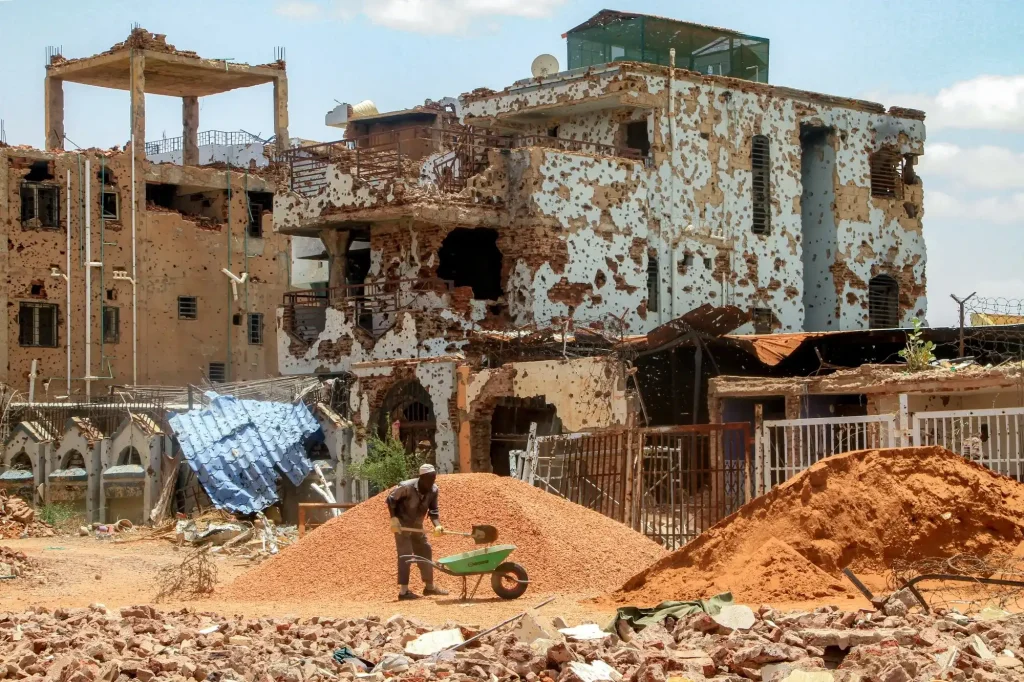
Refurbished Offices vs. Bullet-Pockmarked Streets
The transition back to normalcy remains a tale of two cities. While central government headquarters have been refurbished, many ministry buildings remain abandoned, their walls still scarred by years of heavy fighting.
For the local business community, the road to recovery is even more complex. On Liberty Street—once the city’s primary commercial hub—only a handful of looted shops have managed to reopen.
Challenges for local merchants include:
- Supply Chain Collapse: Before the war, traders relied on credit and deferred payments. Now, suppliers are demanding immediate repayment for inventory destroyed during the conflict.
- Legal Battles: Many business owners, such as appliance seller Osman Nadir, face legal action from creditors despite having lost their entire stock to looting.
- Lack of Capital: Residents have little to no disposable income, causing potential customers to walk away when they see post-war prices.
The Human Cost of Displacement
More than a third of Khartoum’s nine million residents fled during the 2023 occupation. While over a million people have returned since the army retook the city, essential services like water and electricity remain inconsistent, and the international airport stays closed.
The economic reality is stark for returnees. Halima Ishaq, a tea seller and mother of five, recently returned from the south. She currently earns between 4,000 and 5,000 Sudanese pounds a day—less than two euros. This represents just one-third of what she earned before the war began in April 2023.
Restoring Cultural Landmarks
Reconstruction efforts are not limited to government buildings. Volunteers have begun repairing the historic National Theatre near the Nile. While the stage where legends like Louis Armstrong once performed is intact, the sound and lighting systems were completely destroyed.
Similarly, work has commenced at Al-Merreikh Stadium, known as “the Red Castle.” Although the pitch has been leveled, the home of one of Africa’s oldest football clubs remains silent. The team has been forced to compete in Rwanda’s top division since the war began.
A Massive Financial Hurdle
The scale of the task ahead is immense. The United Nations estimates that rebuilding Khartoum’s essential infrastructure will require at least $350 million. As official visits to the city multiply and promises of aid increase, the people of Khartoum continue to wait for the basic services that will make a full return possible.
READ ALSO: Chef Hilda Baci Confirmed as Three-Time Guinness World Record Holder