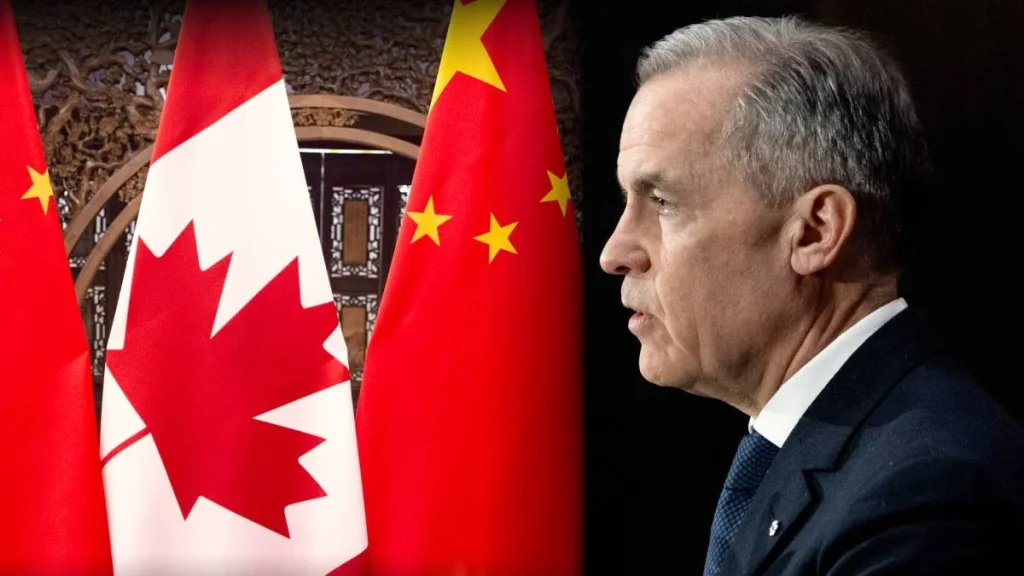
Canada is officially looking beyond North America for its economic survival. In a decisive move to reduce reliance on the United States, Prime Minister Mark Carney has signed a sweeping energy framework with Chinese leadership in Beijing.
The Mark Carney China visit 2026 represents a massive geopolitical pivot. It is the first time a Canadian Prime Minister has visited the superpower since 2017, ending nearly a decade of diplomatic deep freeze.
Escaping the Shadow of U.S. Tariffs
The motivation for this renewed friendship is clear: economic necessity. With U.S. President Donald Trump enforcing aggressive new tariffs and questioning the future of the USMCA, Ottawa faces an urgent need to diversify.
Currently, 75% of Canadian exports flow south of the border. By engaging China—Canada’s second-largest trading partner—Carney is attempting to build a safety net against the volatility of American trade policy.
Natural Resources Minister Tim Hodgson, who accompanied the Prime Minister, emphasized that China is seeking stable partners who do not weaponize energy exports. This creates a lucrative opening for Canadian resources.
Inside the New Energy Roadmap
The centerpiece of the visit was Thursday’s signing of an “economic and trade co-operation road map.” This agreement opens the floodgates for collaboration in three critical sectors:
-
Natural Resources: Expanded trade in oil, liquefied natural gas (LNG), and natural uranium.
-
Investment: New pathways for Chinese capital to enter Canadian agricultural and consumer markets.
-
Technology Exchange: Beijing is eyeing Canadian expertise in aerospace and advanced manufacturing.
Prime Minister Carney described the agreement as a necessary step to navigate “global division and disorder.”
The Mark Carney China Visit 2026: Addressing the “Irritants”
Despite the handshakes, significant friction remains. The two nations are still locked in a retaliatory tariff battle that began two years ago.
In 2024, Canada slapped a 100% tax on Chinese Electric Vehicles (EVs). Beijing fired back in 2025 with heavy duties on Canadian canola and farm goods.
Industry Minister Mélanie Joly confirmed that talks to resolve these “trade irritants” are active. While Thursday’s meetings with Premier Li Qiang and top legislator Zhao Leji yielded no immediate truce on tariffs, both sides pledged to continue constructive dialogue.
A Critical Finale Awaits
The stakes for this diplomatic reset are high. Carney hailed the trip as the dawn of a “new era of relations,” but the ultimate test comes Friday.
The four-day mission will conclude with a face-to-face meeting between Prime Minister Carney and President Xi Jinping. This final session is expected to determine if this strategic partnership can truly balance Canada’s economic needs with its national security interests.