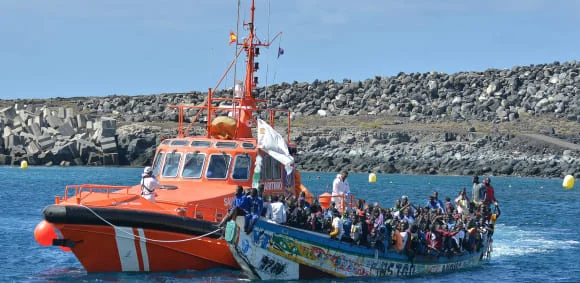
For Moktar Diallo, the dream of Europe has stalled in a brick factory on the edge of the Sahara. Ten years ago, he left conflict-ridden Mali with hopes of crossing the Atlantic from Mauritania to Spain’s Canary Islands. Today, he finds himself trapped in a coastal limbo, laboring for meager wages while hiding from a police crackdown that has effectively shut down one of the world’s busiest migration routes.
Diallo spends his days making bricks under the searing sun and his nights sleeping in a corrugated iron hut with three other men. To avoid the heat—and the police—they often work at night. He earns between $5 and $7 a day, a fraction of the $2,700 smugglers now charge for a crossing that is increasingly impossible to attempt.
“Since the police started turning people back, everything has gone wrong,” the 42-year-old said. He rarely leaves the worksite unless escorted by his boss, fearing he will be rounded up and deported like so many others he knows.
The Deal That Closed the Door
Diallo’s paralysis is the direct result of a geopolitical shift. Early last year, the European Union signed a massive financial pact with Mauritania, aiming to stem the flow of irregular migration from West Africa.
The deal, worth approximately €210 million ($247 million), provides funds for border management, humanitarian aid, and job creation. It signals a broader European strategy to police its borders from transit countries like Tunisia and Egypt, long before migrants ever reach the Mediterranean or the Atlantic.
On the ground, the impact was immediate. Following multiple visits by Spanish leadership to Nouakchott, the Mauritanian security apparatus tightened its grip. The results are visible in the data:
- Interceptions: Security forces have stopped roughly 13,500 boats destined for the Canaries since the start of 2024.
- Arrivals: Successful crossings to the Spanish archipelago dropped by 59% in the first ten months of 2025 compared to the previous year.
- Expulsions: Deportations from Mauritania nearly doubled in the first half of 2025 compared to the entirety of 2024.
A “Clean Sweep” and Human Costs
For migrants, this policy shift has turned Nouakchott into a trap. Witnesses report that a severe crackdown began after Ramadan in late March. Police patrols have become aggressive, sweeping through neighborhoods and worksites.
Rights advocates allege that due process has largely vanished. Many migrants are reportedly detained and dumped at the borders of Mali or Senegal with little money and no transport. There are widespread accounts of human rights violations, including beatings and abuse by security forces, though authorities maintain that operations respect human rights.
“When you look the other way and ignore the rights violations… that is essentially paying these countries to do the dirty work,” noted one researcher regarding the EU’s funding.
Spain has bolstered this effort on the ground, deploying civil guard officers, patrol boats, a helicopter, and a surveillance plane to aid Mauritanian forces.
No Way Forward, No Way Back
The crackdown has left thousands in a desperate bind. Returning home is often not an option. For Malians like Diallo, their homeland is ravaged by an insurgency led by al Qaeda-linked jihadists. Consequently, Mauritania now hosts roughly 500,000 Malians, making them the largest migrant group in the country.
“Here we can manage to find a little money. Over there, there are wars and no jobs,” Diallo explained.
Moussa Kolongo, a 38-year-old taxi driver, shares this sentiment. He had hoped to save enough driving his auto-rickshaw to buy a seat on a boat. Now, police checkpoints make it too risky to work. “They are out on the streets every day, they stop everyone, even refugees,” he said.
The Balloon Effect
While the Mauritanian route has been squeezed shut, migration experts warn that the flow of people has not stopped—it has simply moved. As enforcement tightens in one area, new, potentially more dangerous routes emerge elsewhere.
Reports indicate that boats are now launching from much further south, from nations like The Gambia and Guinea. Recent figures show a stark contrast: while only a handful of boats managed to reach the Canaries from Mauritania in the last six months, dozens have arrived from these more distant departure points.
For men like Diallo and Kolongo, however, these geopolitical maneuvers mean little. They remain stuck in the sand, unable to move forward toward their dreams and unable to return to the nightmares they left behind.
READ MORE: ISIS Ideology Linked to Deadly Sydney Hanukkah Attack, Police Confirm