
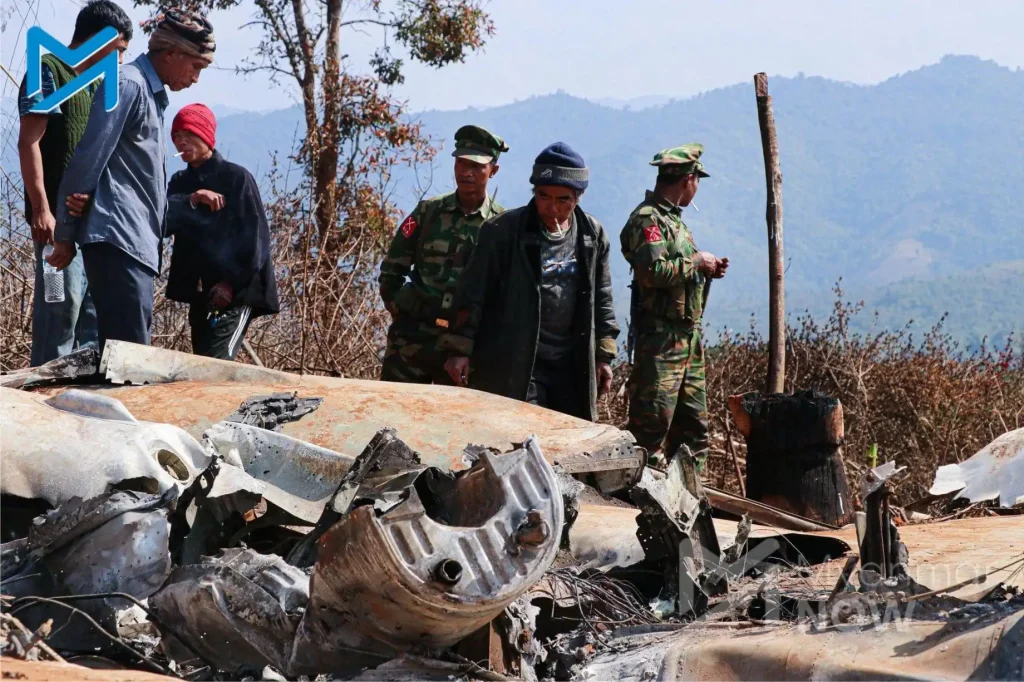
The momentum in Myanmar’s bloody civil war has shifted. After years of defensive retreats, the military regime is aggressively reclaiming territory. A strategic overhaul, swelled ranks, and external diplomatic pressure now fuel their advance.
Rebel forces once swept through borderlands with speed. Now, they face a revitalized adversary. The Myanmar junta has pivoted from reactive measures to a calculated offensive. They aim to crush resistance before the general elections scheduled for December 28.
The “Human Wave” Strategy
The battlefield reality has changed since the 2021 coup. Fighters on the frontlines report a new military strategy. The junta has adopted “human wave” tactics. They sacrifice massive numbers of infantry to overwhelm opposition defenses.
Rebels witnessed this brutal persistence firsthand during recent clashes in Pazun Myaung. This strategic village sits between Yangon and Naypyidaw.
“After one soldier died, another one came up to take his place,” rebel fighter Khant stated regarding the October hostilities.
Khant noted that these advancing troops appeared to be under direct threat from their own commanders. Fear forced them forward. This marks a sharp departure from previous years. Formerly, junta units often broke rank and fled when casualties mounted.
“It was essentially an offensive using all the power they could muster,” recalled Htike, another fighter who survived the onslaught.
Drone Warfare and Foreign Tech
A sophisticated expansion of air power complements the infantry surges. The junta no longer relies solely on conventional airstrikes. They have integrated a vast fleet of unmanned aerial vehicles (UAVs).
Data from the Armed Conflict Location & Event Data Project (ACLED) highlights this shift. The military now operates at least 19 distinct drone models.
The army sources these assets from Russia, China, and Iran. Commanders use them for suicide attacks and high-level surveillance. This provides deadly precision against rebel strongholds.
Conscription Fills the Ranks
Manpower shortages were previously the regime’s Achilles’ heel. Draconian policy changes have addressed this weakness. A mandatory conscription law enacted in February 2024 has funneled new troops into the armed forces.
Estimates suggest 70,000 to 80,000 recruits have joined the ranks. The military has executed approximately 16 conscription rounds. They engage roughly 5,000 individuals per batch.
Simultaneously, the regime purged its command structure. Top officials removed ineffective officers promoted via nepotism. This move followed the humiliating losses of Operation 1027.
Combat-experienced commanders replaced them. These leaders now rotate units to ensure soldiers rest. The junta lacked this strategic advantage in the war’s early stages.
The China Factor Stifles Resistance
Geopolitics plays a massive role in this resurgence. Beijing prioritizes regional stability. Reports indicate they have increased pressure on resistance groups to cease operations.
Chinese mediation recently facilitated the return of Lashio to junta control. Furthermore, Beijing has leveraged its influence over powerful groups like the United Wa State Army (UWSA). They urged the UWSA to sever weapon supply lines to other rebel factions.
In Mogok, a hub for ruby mining, the effects are undeniable.
“If you look into the underlying reason why we can’t compete and are losing ground… it is ultimately due to pressure from China,” explained Sanay, a local fighter.
A Volatile Path to Elections
This military pivot arrives just weeks before the nation heads to the polls. International observers have condemned the upcoming election as illegitimate. They cite the continued incarceration of opposition figures like Aung San Suu Kyi.
However, the junta appears determined to secure its footing before the vote.
“We will see more armed clashes and more attempts from the military to retake territories in the coming three years,” warned Min Zaw Oo, executive director of the Myanmar Institute for Peace and Security.
Fighters like Khant faced a week of artillery fire and drone bombardment in Pazun Myaung. They eventually retreated. For them, the war has entered a more dangerous, desperate phase.
_______________________________________________________________________________________________________________________________
Dangote Group Appoints Ex-CBN Director Mahmud Hassan as Chief Economist