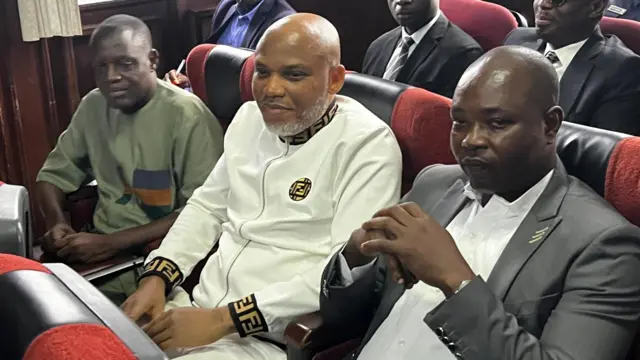
A Federal High Court in Abuja convicted Indigenous People of Biafra (IPOB) leader Nnamdi Kanu on all seven terrorism-related charges Wednesday, sentencing him to life imprisonment after a decade-long legal battle that has deepened ethnic tensions in Nigeria’s southeast.
Justice James Omotosho delivered the verdict in a heavily secured courtroom, rejecting prosecutors’ calls for the death penalty and opting for life terms on four counts, with concurrent five-year sentences on the remaining three. Kanu, 58, was removed from the proceedings earlier due to disruptive behavior but was present for the sentencing.
Background: A Decade of Legal Drama
Kanu’s ordeal began in October 2015 when he was arrested in Lagos upon returning from the UK, where he founded IPOB in 2012 to advocate for an independent Biafra state in southeastern Nigeria. Charged under the Terrorism (Prevention) Amendment Act, the case saw multiple judges recuse themselves amid Kanu’s challenges to the court’s jurisdiction.
Released on bail in 2017, Kanu fled to Israel, resurfacing via online broadcasts. Nigerian authorities rearrested him in Kenya in June 2021, allegedly through extraordinary rendition, sparking international outcry from human rights groups and the UK government, which holds his dual citizenship. He has since been held in solitary confinement by the State Security Service (DSS), alleging torture and demanding transfer to Kuje Prison.
The Supreme Court upheld the trial’s legitimacy in December 2023, paving the way for Omotosho’s ruling.
The Charges and Court’s Reasoning
Prosecutors, led by Adegboyega Awomolo, presented five witnesses alleging Kanu’s Radio Biafra broadcasts incited violence, enforced “sit-at-home” orders causing economic shutdowns, and promoted attacks on security forces and civilians. Key counts included:
- Membership in a terrorist organization (IPOB, proscribed in 2017).
- Incitement to violence and managing an unlawful society.
- Terrorism acts, including importing radio transmitters for propaganda.
Omotosho ruled the evidence proved Kanu orchestrated destabilizing activities leading to bloodshed. “Kanu showed no remorse and remained arrogant,” the judge said, but noted global aversion to the death penalty, commuting it to life on counts 1, 4, 5, and 6, plus five years on count 7. He ordered forfeiture of seized transmitters and restricted Kanu from digital devices in custody.
Reactions: Jubilation from Government, Fury from Supporters
Federal officials celebrated the outcome as a rule-of-law triumph. Information Minister Mohammed Idris called it “justice served,” while Awomolo said, “No one is above the law.” The government highlighted IPOB-linked violence’s toll: over 700 deaths and $5.3 billion in economic losses since 2021, per SBM Intelligence estimates.
Southeast voices decried the verdict as politically motivated. IPOB spokesman Emma Powerful vowed “total shutdowns,” labeling it a “death sentence for Biafra.” Activist Omoyele Sowore called it “premeditated,” and NBA’s Efobi deemed it “irresponsible.” Fears of reprisals mount, with heightened security in Igbo heartlands.
Broader Implications for Nigeria
The conviction echoes Finland’s September 2025 sentencing of another Biafra agitator, Simon Ekpa, to six years for terrorism. It underscores Nigeria’s hardline stance on secessionism amid southeastern unrest, but critics argue it ignores root causes like marginalization. Kanu’s lawyer, Aloy Ejimakor, plans an immediate appeal, citing repealed laws and rendition violations.
As Kanu is led to protective custody, Nigeria faces a crossroads: will this quell agitation or ignite further division in a nation still healing from its 1967-1970 civil war scars?